If a single term is sought for the character attribute generated by Satan’s ambivalent presentation, the most suitable term appears to be ‘depth’.
—John Carey, in 'Milton’s Satan', from A Cambridge Companion to John Milton
Since the eighteenth century, Milton scholarship has been consistently undecided about how to interpret Satan. Some critics perceive in him a superior, tortured heroism, worthy of admiration and sympathy. A revolutionary figure in many respects, Satan is epically and indefatigably defiant against a tyrannous order, and his struggle for self-will and autonomy is intensified by the profound personal suffering that accompanies it. Other readers are less sympathetic, interpreting his pride, blatant self-contradictions, and dissembling rhetoric as indicative of a dangerous egomaniac. From this anti-Satanist perspective, Satan is malicious and debased, a false hero (if a hero at all), serving as a cautionary figure for Milton’s readers.
Carey emphasizes that the dynamic tensions and ambivalences in Satan’s character confer upon him ‘depth’ and some of the most remarkable lines of poetry in Paradise Lost. Satan’s past as the beautiful Lucifer, one of the most resplendent of God’s loyal Archangels, arguably glints through and complicates his burning desire for revenge, imbuing it with guilt, shame, and regret.
Light-bringer
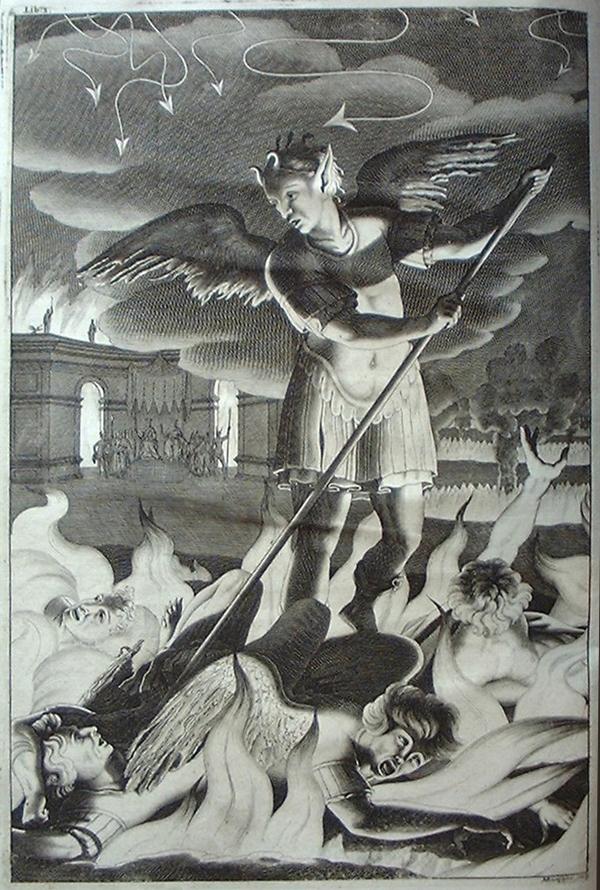
The name ‘Lucifer’ means ‘light-bringer’ in Latin, whereas ‘Satan’ signifies ‘the adversary’ in Hebrew. Satan receives his fallen name for the first time in Book 1 when he is introduced as ‘the arch-enemy, | And thence in heaven called Satan’ (1.81). He is defined primarily by his relation to God and is often presented in mournful contrast to his former beauty: ‘the excess | Of glory obscured’ (1.593). Satan was once a glorious angel of God, good rather than evil, and the motif of the ‘bright angel’ continually reminds the reader that he is choosing to defy his creator and, by extension, his own origins. This aligns with St Augustine’s conception of evil as not inherent, but chosen; evil exists through conscious opposition to God’s will enacted through free will.
Free Will
The allure of free is where the attractiveness and power of Satan’s character lie. Although ineffective in confronting the omnipotence of God, Satan believes himself free in his will and mind: ‘What though the field be lost? | All is not lost; the unconquerable will’ (1.105). He may be defeated in physical or divine conflict, yet he continually asserts that his will remains unconquered, a resilience reminiscent of St Paul’s declaration in 2 Corinthians 4:8-9: ‘perplexed, but not in despair; cast down, but not destroyed.’
Satan’s assertion that ‘the mind is its own place, and in itself | Can make a heaven of hell, a hell of heaven’ (1.254) asserts the subjective construction of reality through free will, despite the evident bitterness of exile. In hell, Satan feels himself sovereign, free from the obligation to worship the Son. When he enters Eden, he is tormented by ‘the hot hell that always in him burns’ (9.467). This depiction represents both the physical torment of hell and its psychological extension, illustrating that this suffering is of Satan’s own making, shaped by his envy and hatred of all that is good. His mind is not only resilient and oppositional to God, but it also influences others to exercise free will against divine authority.
Satan’s persuasive abilities are central to the narrative. His speeches in the early books of Paradise Lost are instrumental in shaping the plot: he convinces the angels to rebel and persuades Eve to eat the forbidden fruit. Through eloquence and charisma, Satan tempts others, encouraging reflection, questioning, and the exercise of free will, reinforcing the poem’s exploration of autonomy and moral agency.
Satan’s Speeches
As the poem progresses, Satan’s role as a speaker diminishes. In Books 1 and 2, he dominates the narrative through direct speech, addressing the fallen angels. In contrast, Raphael recounts Satan’s revolt to Adam, mediating his oratory through reported speech. The narrative framework thus begins to limit Satan’s influence and assert the poet’s divinely-authorised perspective and authorial control.
In Book 9, Satan addresses Eve in a ‘human voice’ (9.561), employing persuasion rather than command, demonstrating subtle influence rather than martial power. Book 10 depicts his ultimate humiliation when he and his followers are transformed into serpents and deprived entirely of speech:
he would have spoke,
But hiss for hiss returned with forkèd tongue
To forkèd tongue. (10.517)
Here, the narrative emphasizes Satan’s silencing; his speech, once central to the poem’s action, is reduced to hiss-like imitation. This shift underscores the prominence of God’s word and authority, establishing that at the poem’s conclusion, only divine majesty remains unchallenged