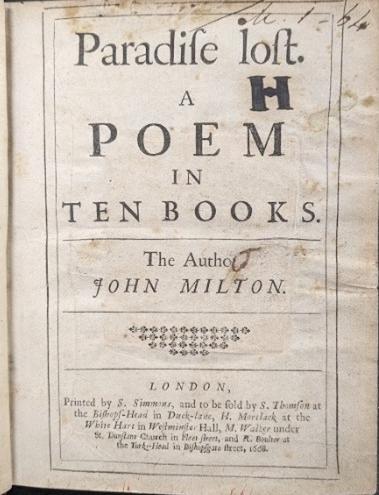
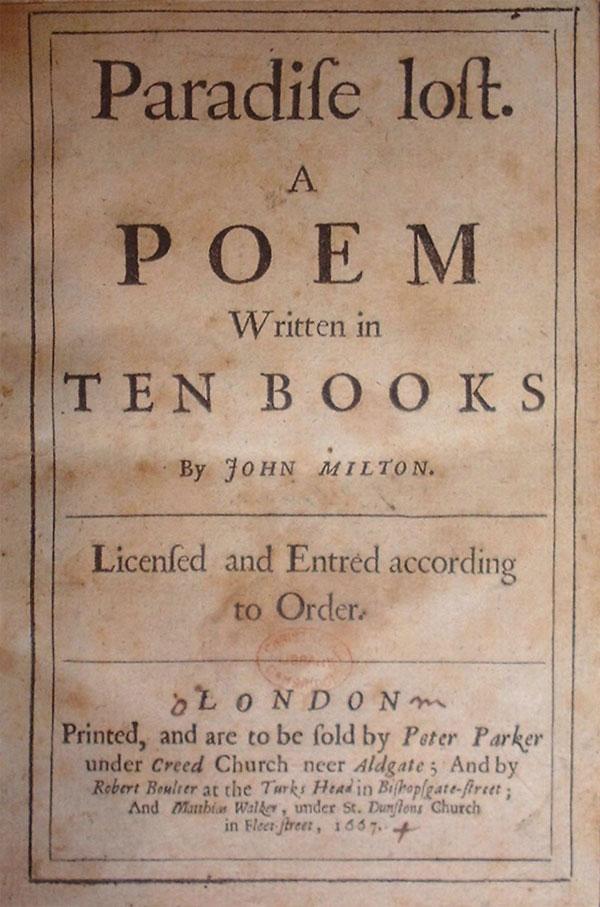
This title page poses and answers some very important questions about the book it contains. From it we can often learn what edition and copy of the book we are looking at and how its author and publisher wished to present it to the world (see the Glossary of terms below). Sometimes we cannot fully trust this information, however.
WHAT are we looking at? As the critic John Hale notes (see Works Cited below), the title ‘Paradise Lost’ is Latinate, reflecting Latin’s grammatical tendency to use ‘a predicative past participle to avoid abstract nouns’: it means ‘the losing of Paradise’ not ‘the lost Paradise’, by analogy with works like Livy's Ab urbe condita ('From the founding of the city') or Tasso's Gerusalemme Liberata ('Jerusalem Delivered'). The title uses what’s known as the ‘long s’, which remained a common typographical feature until the early nineteenth century.
We also learn that this is ‘a poem written in ten books’. This indicates that this is the first edition of Paradise Lost, as the second edition was reorganized into the more widely recognised twelve books which we tend to find in our modern editions today.
WHERE was the book published? This edition was published in London. Historically, however, it was not uncommon to lie about the publication place. If, for example, something was treasonous or the content went against the laws of a country, publishers would sometimes lie about where it was published. Amsterdam was a common city for this as it was associated with a printing freedom that England did not necessarily have.
WHEN was this book published? 1667, confirming that it is the first edition. Knowing the date a book is published is often the most important factor in determining its edition. There were 1,300 copies printed for the first edition of Paradise Lost; Christ’s College Library holds an impressive six of these!
WHO is the author of the book, and WHO is the publisher? John Milton's name is clearly and boldly stated on the title page, asserting authorial ownership of his epic poem. It was common to publish under pseudonyms, or even anonymously; this route was sometimes taken by authors if their work was particularly ‘scandalous’. Even Milton initially published his work, The Doctrine and Discipline of Divorce, anonymously in 1643.
Although Milton claims ownership here, the publisher’s name is cautiously omitted from this title page… We now know the publisher was Samuel Simmons. Perhaps he deliberately removed his name in fear of falling into disrepute over Milton’s politically and religiously challenging writing.
Milton’s epic didn’t exactly fly off the shelves…