Timeline
Explore Milton's lifetime via this selective timeline of its major events. Scroll through and select dates to find out more.

Explore Milton's lifetime via this selective timeline of its major events. Scroll through and select dates to find out more.
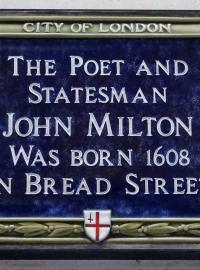
The story starts on 9 December 1608, a decade that saw the accession of King James I and the first performances of Shakespeare's King Lear and Ben Jonson's Volpone.
Our protagonist was born in Bread Street, London, an important street that also housed the Mermaid Tavern, which was patronised by many notable literary figures of the time. His father, John Milton senior, was a successful scrivener (a sort of solicitor and money-lender) as well as a respected amateur musician.
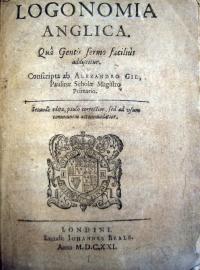
Despite having been disinherited by his Catholic father for vigorously embracing Protestantism, John Milton senior provided a very good education for his son, sending him to St. Paul's School and employing a string of private tutors. From a young age our poet showed a proclivity for academia, particularly in languages - and from the age of twelve, he regularly stayed up past midnight to study.
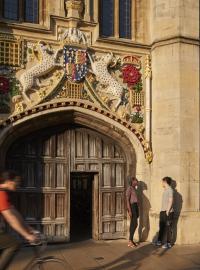
In 1625, at the age of sixteen (rather late for the time) Milton started his studies at Christ's College, Cambridge. It seems he was a bit of an outsider: he was nicknamed the 'Lady of Christ's' for his effeminate ways and youthful looks, and was in his turn scornful of the majority of his peers, disparaging their buffoonery and carousing. Occasionally he found the curriculum just as frustrating: in a verse letter to his best friend, Charles Diodati, Milton wrote of having been suspended over a clash with his tutor. His bombastic, yet playfully tongue-in-cheek, sense of self-worth is attested by his comparison of his own suspension to Ovid's exile from eighth-century-BC Rome.
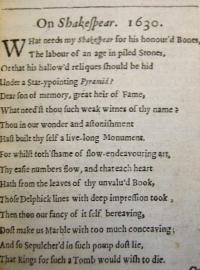
In poems and exercises written during Milton's time at Cambridge, we see the seeds of poetic ambition germinating, and witness his growing interest in the English language and the service to which it could be put. Throughout this period he wrote a number of notable short poems including 'L'Allegro' and 'Il Penseroso'. His poem 'On Shakespeare' was published in the Second Folio of Shakespeare's plays in 1632, the year he graduated from Cambridge with his MA:
Thou in our wonder and astonishment
Hast built thyself a live-long monument.
Milton then spent a period of time at his father's home in Hammersmith (and later Horton) in private study - critics now consider this his poetic apprenticeship. Works of this period include the masque Comus, a courtly entertainment celebrating chastity in the face of temptation, written for an aristocratic family who had recently been involved in a licentious scandal. Compared to his later years, this was a rather tame period for Milton: although he felt he was destined for greatness, he had the maturity to see that he wasn't ready to compose a masterwork just yet. Indeed, as well as the self-aggrandizing sections of his writing that are frequently noted, the concurrent theme is that of the piety of waiting for grace.
Towards the end of this period a young fellow at Christ's, Edward King, died in a shipwreck. In 1638 a book of poems composed by members of the college was published. Milton's pastoral elegy, 'Lycidas', was the outstanding contribution, and is now regarded as one of the greatest lyric poems in the English language. The genre of elegy has many interesting tensions; its works are prompted by and presented as an emotional outpouring of grief, but often serve as self-conscious apprenticeship pieces for aspiring poets. Milton's complex poem mourns the loss of one so young, but also sees a galvanization of intent for the poet to rise to greatness, spurred on by fear at the example of King, a man cut down in his prime before glory had been achieved. Milton also takes the opportunity of contemplating King's piety to level some heavy criticism against the church in the first sally of his long attack against the prelates (or bishops).
Now, Lycidas, the shepherds weep no more:
Henceforth thou art the Genius of the shore,
In thy large recompense, and shalt be good
To all that wander in that perilous flood.
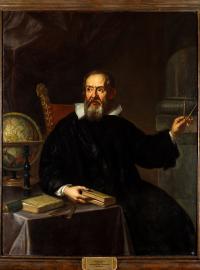
In 1638, still unknown in England, Milton embarked on a fifteen-month Grand Tour (see Glossary below), as many young middle and upper-class men did after university. He spent most of his time in Italy, and in spite of his anti-Catholic views, happily mingled with the literati and intelligentsia (including Galileo, then under house arrest for heresy; Milton would later include him in Paradise Lost). Milton's poems in Latin and Italian won him great respect as a contemporary literary figure, but his return was a sharp comedown from this time of contentment. There were both personal and national hardships ahead. Charles Diodati had died, prompting the poem Epitaphium Damonis, a beautiful but heart-rending poem of genuine loss - and following political turmoil England now rested on the verge of civil war.
Despite his desire to write about the legends of King Arthur, Milton could not just turn his back on civil injustice. He postponed his own creative ambitions to focus on prose - or as he called it, the work of his left hand - and devoted himself to propagating his unorthodox belief in liberty. He first became involved in religious dispute on the Presbyterian side by writing a series of anti-prelatical tracts in 1641-2. As well as being learned and intellectual, they are also filled with clever and amusing rhetoric, satire and invective. His Puritan views supported his call for the suppression of the Catholic idolatry that he and others felt was increasingly present in the Church of England. At this stage Milton hadn't rejected monarchism, and he believed that the bishops were a threat to England and to the King.
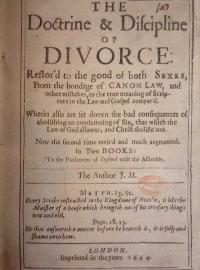
In 1642 Milton married, perhaps unwisely, the seventeen-year-old Mary Powell, a girl from an unintellectual, royalist family. After a few weeks she went to visit her family and didn't return. It has been suggested that the outbreak of the first civil war, which initially went Charles I's way, may have made the Powells indisposed to favour their troublesome reformist son-in-law. These difficulties prompted Milton to write four tracts in favour of divorce on the grounds of incompatibility (at the time divorce was only granted on grounds of adultery). Although Milton was motivated by a very high and pure ideal of marriage as an intellectual union, he was publicly attacked on all sides for libertinism.
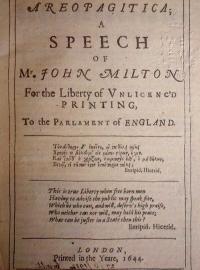
His later pamphlets develop his notion of Christian liberty and the idea that God imbues the good Christian with the reasoning faculties to govern himself without recourse to worldly authority: this was considered a very dangerous and anarchical idea. The government's attempt to suppress his ideas prompted the 1644 publication of Areopagitica, a treatise rejecting censorship before publication and arguing for freedom of inquiry (although Milton still reserved the right for governments to censor works after publication if they were immoral or went against Protestantism). Milton believed in the strength of truth and the importance of man being free to choose it.
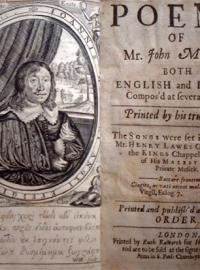
Read about Milton's first volume of poetry here
Later in the 1640s, Milton, who was working as a private tutor, was reconciled with his wife, and she bore him a number of children. His home life at this time was not particularly content; a number of Mary's family moved in with the Miltons, creating a noisy atmosphere which was not conducive to study or writing. As well as the pamphlets, Milton was also working on a history of Britain.
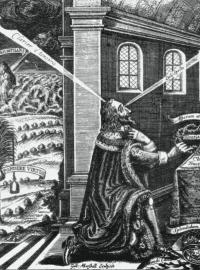
Two weeks after the execution of Charles I in 1649, Milton committed himself to the Republican side by publishing The Tenure of Kings and Magistrates in support of the regicide. His argument (which would be directly opposed in 1651 by Hobbes’ Leviathan), was that a monarch's power is not absolute, but derived from the people he rules and held in accordance with a social contract. If a monarch breaks this contract by abusing his position, the people have the right to remove him from power. A few months later, Milton was appointed Secretary of Foreign Tongues to the Council of State; it was his job to translate documents and to write defences of the Commonwealth against Royalist attacks. Milton’s Eikonoklastes ('Image Breaker' in Greek) was also published in this year. This was a defence of the Commonwealth published in response to Eikon Basilike ('The Image of the King'): a piece of royalist propaganda supposedly written by the late King Charles I.
By the end of 1651, Milton's sight, which had been deteriorating since 1644, failed him completely. He was 43, blind, and with his great work still yet to be written. (Milton comments sadly on his blindness in the opening of Book 3 of Paradise Lost, and also in the powerful 'Sonnet 19', commonly known as 'On his Blindness').
Milton's wife Mary also died yet, despite these misfortunes, he persevered with his secretarial duties until 1659, and published his last major pamphlet in 1660. It was a brave anti-monarchical protest in the face of the coming Restoration, expressing despair at seeing his countrymen so eager to run back to servitude. Much like Abdiel in Book 5 of Paradise Lost, Milton was a lone but stalwart adherent to a greater truth in rebellion against a false authority.
Four years after the death of his first wife, Milton remarried - this time, more happily. However his second wife, Katherine Woodcock, died just two years later; Milton made her the subject of the poignant 'Sonnet 23':
Methought I saw my late espoused saint
Brought to me, like Alcestis, from the grave...
He married for a third time in 1663, to Elizabeth Minshul. Milton did not get on very well with his daughters, who were not academic and resented the schooling their father put them to. They stole from him and sold off portions of his library. Still, there is evidence that Milton was a reasonably sociable and agreeable man, amiably receiving visitors in spite of the pains of blindness and gout.
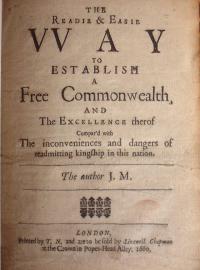
When Charles II assumed control of the country in May 1660, Milton was in serious trouble. A number of Commonwealth leaders were imprisoned or executed, with some choosing to flee abroad for safety. Milton escaped immediate arrest thanks to the efforts of his friends, who hid him throughout the summer - but he still faced penalties. His books were burnt and his name was proposed in Parliament for exclusion from the Act of Pardon to be passed in August. Through the work of friends in high places, Milton wasn't excluded, although he was arrested and held in custody for some months. It’s popularly held that the invocation to Book 7 of Paradise Lost, which talks of his 'mortal voice, unchanged' in spite of 'evil days' and 'dangers compassed round' (23-7), was written in reference to this time. The Readie and Easie Way to Establish A Free Commonwealth was also published in this year.
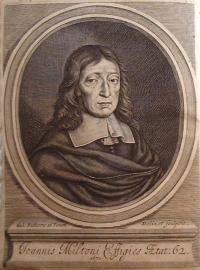
Milton began work on Paradise Lost at some point in the mid 1650s. It was composed orally by dictation to an amanuensis (or scribe) over the next decade, and was published in 1667. Despite Milton's unfortunate political reputation and the lack of serious interest in his previous poetic efforts, the epic was instantly recognized as a work of outstanding merit. These later years were spent in poetic endeavour. Paradise Lost was revised for the second edition in 1674, an enlarged edition of the Poems was published in 1673. Paradise Regained and the shorter epic Samson Agonistes, both probably written in the 1660s, were published in 1671 or 70.
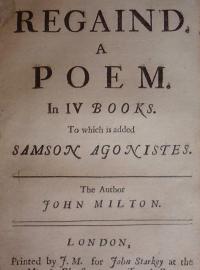
Milton publishes Paradise Regained, the four-book 'sequel' to Paradise Lost, and the biblical closet drama Samson Agonistes, both probably written in the 1660s, were published in 1671 or 70.
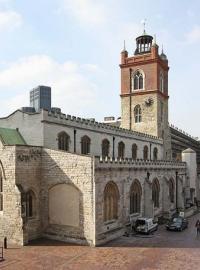
Milton remained in London, with the exception of 1665-66 when he moved with his family to Chalfont St. Giles to escape the plague. This is the only one of Milton's houses which still stands, and it has been opened to the public as a shrine-cum-museum. The house he grew up in, on Bread Street, was destroyed in the Great Fire of 1666. Milton died aged 65 on 9 of November 1674, and was buried at St Giles, Cripplegate (now part of the Barbican Estate). His legacy included some of the greatest works in the English language, and the memory of a man devoted to moral goodness and to liberty, with the strength to stand firm even where others fell.
I cannot praise a fugitive and cloistered virtue, unexercised and unbreathed, that never sallies out and sees her adversary, but slinks out of the race where that immortal garland is to be run for, not without dust and heat.