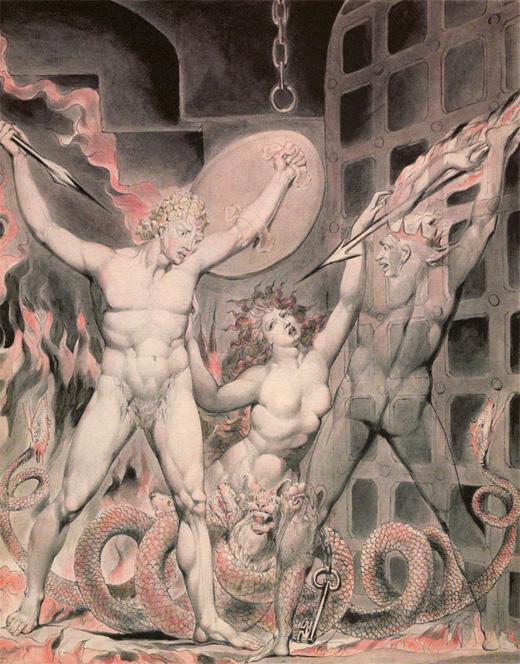
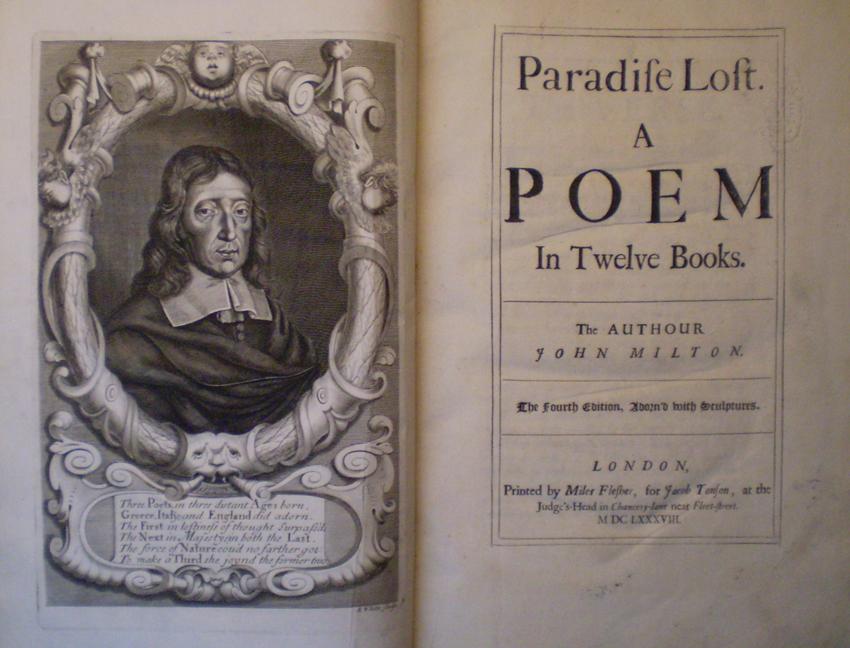
Since its first illustrated edition rolled off the press in 1688, Paradise Lost has fired the imaginations of artists. Generations of painters, draughtsmen and printmakers have tried - and sometimes failed - to create a visual equivalent of Milton's poetry. Between the late seventeenth and early twentieth centuries a flurry of illustrated editions of Paradise Lost appeared. Apart from being beautiful artefacts in themselves, these books and their engraved plates are an invaluable sign of what Paradise Lost meant to the periods that produced them. Satan, for example, looks very different in 1680 to how he looks in 1860.
Along with the shifting tides of artistic taste came new ways of looking at Milton. Paradise Lost's early illustrators drew episodes from the poem with an eye for the emblematic: Satan as a cormorant sitting in the Tree of Life, the golden scales of justice in the sky over Eden. Like Milton himself, these artists looked at the visual world of God's creation and found it filled with deeper symbolism. In the eighteenth century, painters and engravers with a new-found passion for landscape began to look to Milton's epic as a storehouse of the Sublime - the rolling vistas of Eden, or the flaming, subterranean crags of Hell. By the nineteenth century, the age of Jules Verne and H.G. Wells, an artist such as Gustave Doré could produce his extraordinary science fiction image of Satan's flight to earth.
We can learn a lot by comparing how different artists have tackled the same Miltonic scene. Does Satan have horns? Did Michael drive Adam and Eve out of Eden or lead them gently by the hand? Whose fault was the Fall? All these questions have subtly different answers according to who is drawing the pictures and when they are doing so...
Such is the richness of Milton's poem that it can sustain innumerable imaginings of the same scene. Yet as we shall see, some of Paradise Lost's most illustrated tableaux, such as the Temptation or the Expulsion, had a long history in Christian art before Milton. In the minds of illustrators, this familiar trove of Christian iconography sometimes jostles against Milton's re-envisaging of biblical events. But first, let us turn back to 1688, the year Milton's readers were first presented with poetry in pictures...
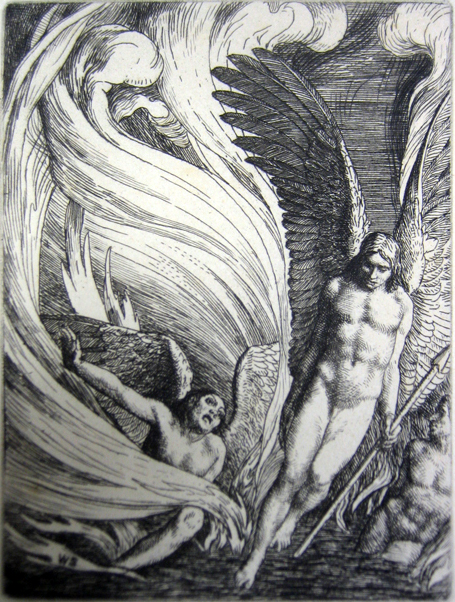 In words like 'views', 'sights', 'visible' and 'ken' (now a rare word that means the range of someone's vision), Milton is repeatedly telling us that there is something to see here. First he sketches out some of the traditional topography of Hell: it is 'waste and wild', a 'dungeon horrible' filled with fire. But as so often in Paradise Lost, Milton's description of the scene turns upon a simile - 'As one great furnace flamed' - and, more particularly, upon the following word 'yet'. Milton's simile conjures up before the mind's eye the image of a roiling furnace, before saying 'no, Hell is not as simple as this'. We can only see Hell's fires by putting together in our imaginations two things that, in reality, are totally opposed. This is what Milton does in the famous oxymoron that gives this website its name: 'darkness visible'.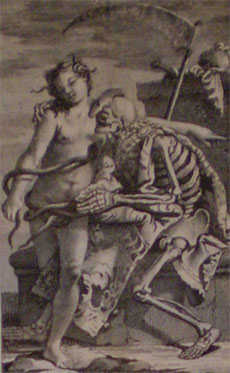
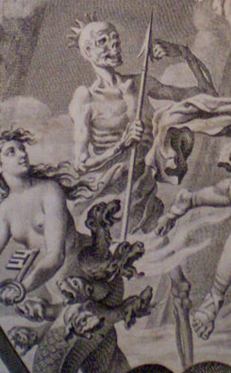
![John Baptist de Medina [?], 1688.](/sites/default/files/inline-images/Death%201.jpg)