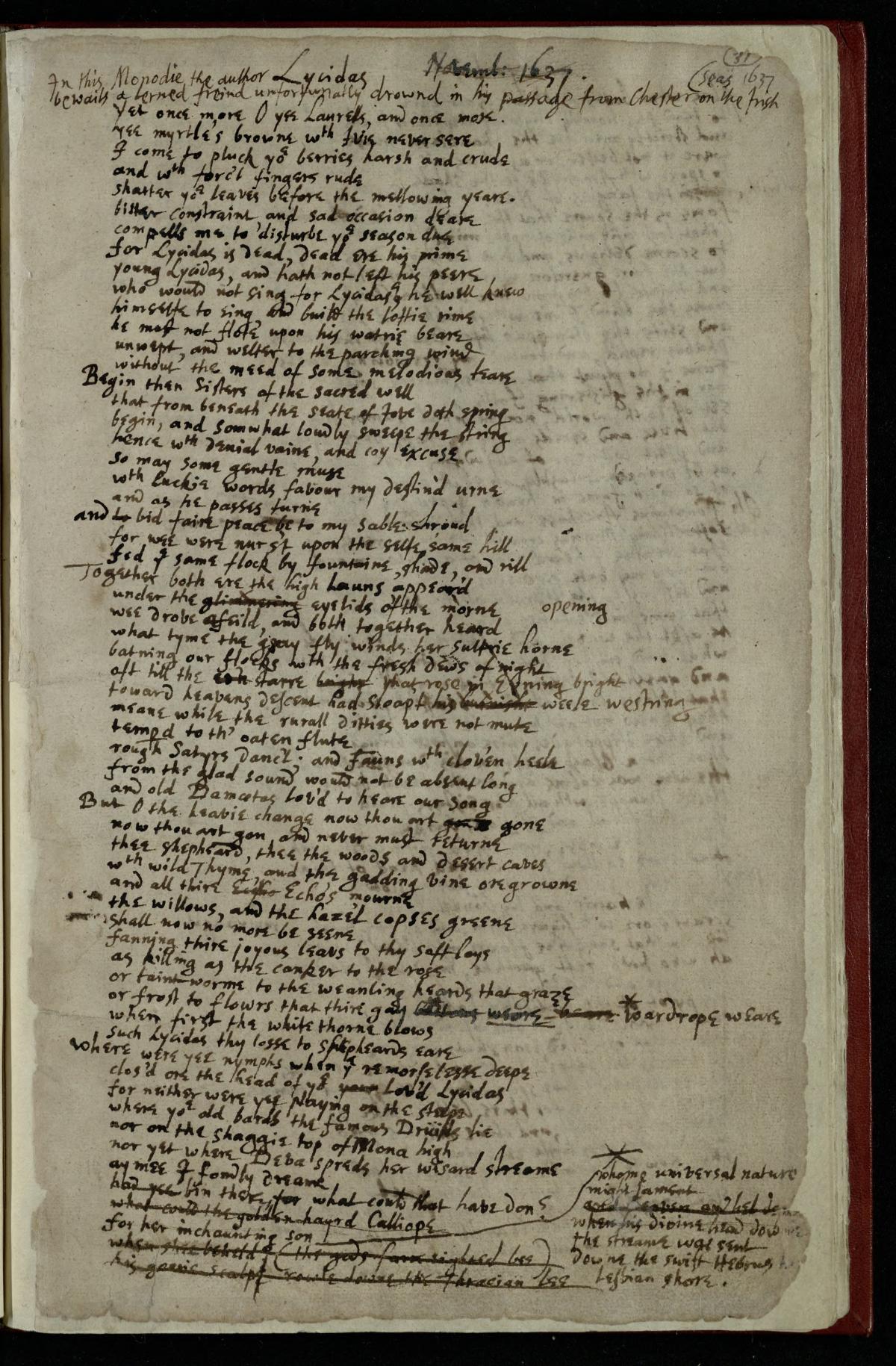
The Romantic ideal of poetry as ‘the spontaneous overflow of powerful feelings’ (Wordsworth) and of the poet who never blots a line (the trait Ben Jonson lamented in Shakespeare) was always a myth, as the Trinity Manuscript reveals. But it was influenced by the blind Miltonic narrator’s descriptions of his own visionary mode of composition in Paradise Lost, which was no mere posture: Milton believed that the ‘unpremeditated verse’ was ‘dictate[d] to [him] slumb’ring’ at night and ‘inspire[d]’ by his Muse (9.22-4). Milton was arguably the strongest poetic influence on English Romantic poets from Blake to Byron, who took inspiration from his radical politics, the sublime scale of his poem, Miltonic blank verse, and the dynamism of Satan as an anti-hero, as well as his visionary, inspired poetics.
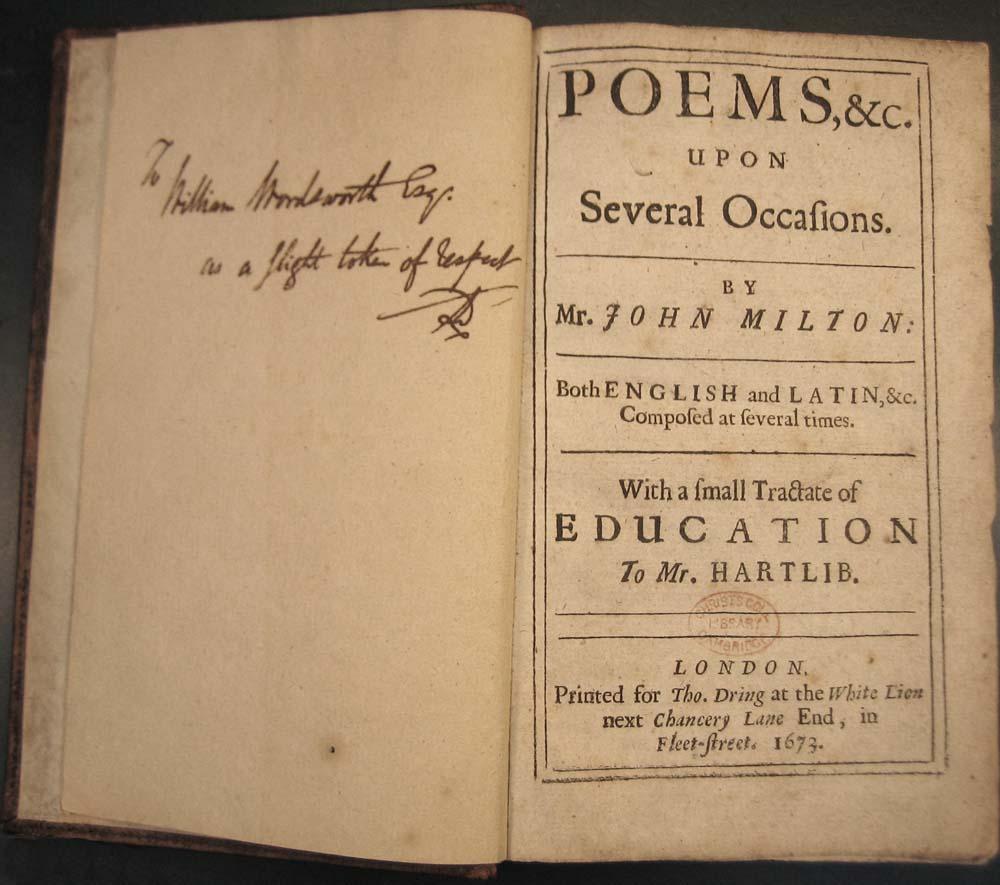
As we see in Lamb’s reaction, they were influenced not only by Milton’s poems, but by the material forms in which they encountered Milton’s texts. Two copies of Milton’s 1645 Poems—the volume in which ‘Lycidas’ is printed—owned by Wordsworth himself are held at Christ’s College: a first edition and a second edition, the former of which Wordsworth had actively sought out. Wordsworth took inspiration not only from the poems in this 1645 volume, but also—especially—from Paradise Lost. Lamb called Wordsworth ‘the best knower of Milton’.
Wordsworth’s long, autobiographical, blank-verse poem The Prelude or, Growth of a Poet's Mind is highly influenced by Milton. In The Prelude, Wordsworth develops an innovation made by Milton in the epic tradition, which is to render the poet himself as a hero of the poem. Many critics across the centuries have identified different heroes in Paradise Lost, with Blake and Shelley famously claiming that Satan is the true hero. In addition to the heroic endeavours of Satan, Adam, and Christ, the poet’s own celestial flights of imagination and poetic work of faith are also figured as heroic by Milton, arguably for the first time in the epic tradition. Wordsworth takes this a step further in his epic of the ‘Growth of a Poet’s Mind’.
In The Prelude Wordsworth describes a heady night of undergraduate drinking in honour of Milton’s name in Milton’s rooms in Christ’s College:
O temperate Bard! … I to thee [Milton]
Poured out libations, to thy memory drank,
Within my private thoughts, till my brain reeled,
Never so clouded by the fumes of wine
Before that hour, or since. (3.299-307)
Wordsworth characterises this Dionysian tribute to Milton’s memory as an ‘unworthy vanit[y]’, implying that, in his youth, he underrated Milton’s temperance in favour of the sublimity of his genius. Like Lamb, the young Wordsworth was carried away with fantasies of Miltonic inspiration and had to moderate them.
The conception of poetic genius in general, and of Milton’s genius specifically, which Lamb’s lines demonstrate was in part a reaction to the earlier eighteenth-century’s more heavy-handed approach to the wholeness and sanctity of great authors’ texts. Highly interventionist editors treated the words of writers including Milton as ‘alterable, displaceable at pleasure’, capriciously altering their lines according to their own sense of decorum and good sense. Richard Bentley’s edition of Paradise Lost was the worst offender in this regard.
Christ’s College also holds the early Romantic poet William Cowper’s copy of Bentley’s edition, which is heavily annotated. Cowper (pronounced ‘Cooper’) was of the generation before Wordsworth and Coleridge, and his conversational, familiar style of poetry was an important influence on theirs. He too was highly influenced by Milton. Cowper’s annotations react strongly against Bentley’s often absurd alterations to Milton’s lines, at times calling them ‘childish’ and ‘below the Dignity of a true Critick’, on other occasions conceding that ‘Bentley is a great critic—but Milton the better poet’! Cowper’s faith in Milton over Bentley does not rely on a conception of the absolute perfection of his lines like Lamb’s, but on an appreciation of the boldness, sublimity and innovation of Milton’s unorthodox uses of language, as well as an early Romantic sympathy with his radical politics.