In attempting to situate Paradise Lost in its political context we face a particular critical choice, which is informed by the specific kind of political context which we have in mind. On the one hand, we can examine the stylistic and argumentative similarities between sections of Paradise Lost and Milton's more explicitly political writings. On the other hand, Paradise Lost can be read as a political allegory, which is to say that events and characters in Paradise Lost can be aligned with aspects of the political context of the poem's creation. But the stylistic similarities between passages of Paradise Lost and Milton's political works are not mere chance - they arise in part because the characters in Paradise Lost find themselves in situations which genuinely are political. In directing his Son to create earth, God conducts an act of rulership, which is inescapably political. These broader political parallels lead us towards a more allegorical interpretation of the poem as a whole.
Is this the region, this the soil, the clime, […]
That we must change for heaven, this mournful gloom
For that celestial light? (1.242-5)
Satan's speeches provide the strongest example of a distinctively political voice appearing in the poem, drawing on rhetorical techniques that saturate Milton’s political prose. Here, he uses a series of rhetorical questions with progressively more contracted syntax in order to assert his point. Satan's attempts to rouse the fallen angels in Book I are further reminiscent of Milton's desire to rally support for the Cromwellian government. But Milton's rhetorical sophistication is demonstrated by the subtle flaws woven into Satan's arguments, expressing his corrupted nature at a particularly detailed level. This can be seen in Book IX:
Indeed? Hath God then said that of the fruit
Of all these garden trees ye shall not eat,
Yet lords declared of all in earth or air? (9.656-8)
When Satan persuades Eve to eat the fruit, Milton strikes a fascinating balance by making Satan’s arguments as convincing as they are misleading. Satan deliberately misunderstands Eve in order to make God's restriction appear more authoritarian and perverse. But beyond this, he implies that there is a contradiction between Adam and Eve having been created as lords over the world and their being restricted from eating the sacred fruit. The implication is gentle, avoiding direct criticism of God and instead pressuring Eve to justify God's prohibition. These examples also demonstrate Satan's ability to modulate between different kinds of rhetorical questioning, much as Milton's prose works combine both blistering interrogation, and the barbed, faux-naïve attitude which Satan adopts towards Eve.
We can begin to see how the great debate in Book II might be read as a political satire, mocking the tiresome debates which Milton both witnessed and conducted in his youth. Similarly, the interaction between Adam and Eve is a nuanced study of gender politics, whilst the relationship between God the Father and God the Son presents an obvious ideal of kingship and the delegation of power. But the danger of such readings is that they quickly lose their specificity, especially when considering characters such as Satan, who accommodates such a wide variety of different allegorical interpretations. He can be seen as a false leader to the fallen angels, his enforcement of his own will on the great debate in Book II recalling Charles I's wilful disregard for parliament. But alternatively, he can be seen to represent something of Milton and Cromwell in their revolutionary struggles against the king. At a slightly more general level he may even represent the failure of any political discourse in this period, and of religious culture which attempts to exist apart from divine authority and biblical revelation. The problem is that Satan is primarily identified as a force of rebellion against God, and Paradise Lost rarely seems to require us to construe him as anything else.

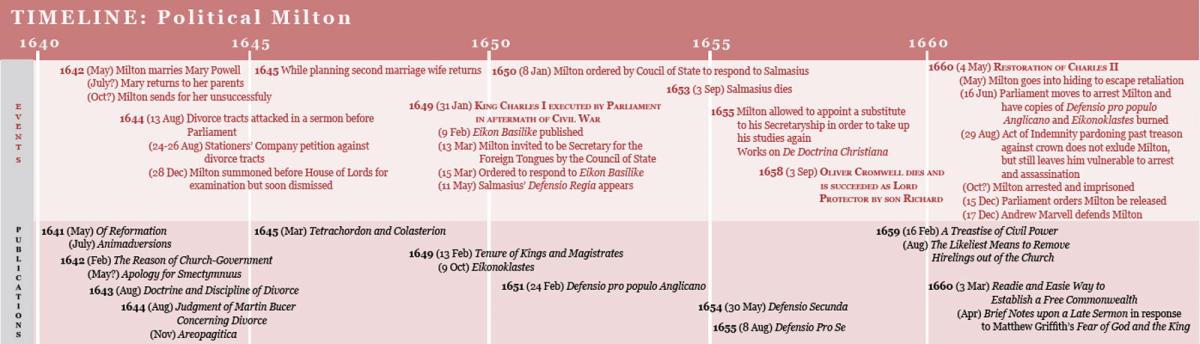
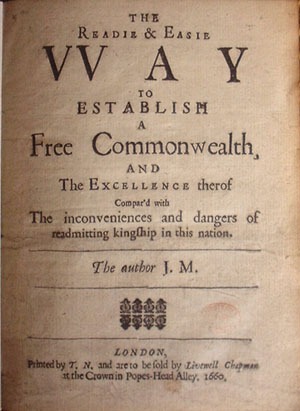 e beginning of a career of political prose writing which would last almost until his death in 1674. Close analysis reveals a subtle change in his thought away from the youthful orthodoxy which had led him to consider ordination as a priest, and towards the increasingly heretical and subversive theology which typifies his later writings. However, the general thrust of his political writings is towards Puritan reformation in the church, and the replacement of the monarchy with a free commonwealth. His enduring support for Cromwell resulted in his appointment in 1649 as Secretary for Foreign Languages, a position which involved acting as the voice of the English revolution to the world at large. He remained stalwart in his belief in the Republic, publishing
 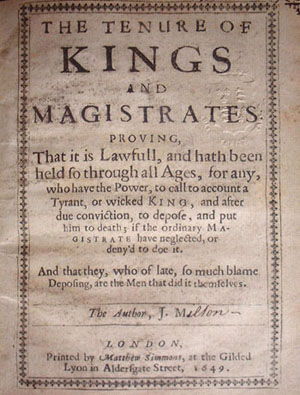 f biblical exegesis and political pragmatism, his influence from classical sources is clear. His definition of a monarch is rather incongruously drawn from Aristotle, and his repeated emphasis on the idea of tyranny evokes both Greek political thought and Latin writers such as Plutarch and Tacitus.