In October 1656, the Quaker leader James Nayler rode into Bristol on a donkey, imitating Jesus Christ’s entry into Jerusalem. Women surrounded Nayler, laying palm leaves in front of him. This incident was debated in parliament for six weeks, with many MPs arguing that Nayler should be put to death for blasphemy. In the end, a more lenient punishment was decided upon, and Nayler had his tongue drilled through. 

In our current age, we generally hold that religion and politics should not institutionally intermingle, since we tend to imagine politics as a public endeavour and religion as private and inherently personal. However, 400 years ago, this distinction would be seen as illogical and even heretical - as we can see by the brutal punishment of Nayler’s blasphemy. In Milton’s day, religious arguments informed and directed polemic on topics which varied from politics, to literature, to fishing. To fully understand Milton and his works, we must meet them on their own turf, existing within the context of historic religious conflict and wider theological debate.

The Reformation

During the later Middle Ages, the European public grew concerned about various problems threatening the church, including corruption, low educational standards for priests, and religious apathy amongst the population – which was believed, in part, to be a result of these aforementioned failings. The early sixteenth century saw theologians such as Martin Luther and John Calvin diagnose the root problem of the church as a separation between its current teachings and the original teachings of Jesus Christ and his early followers. Coinciding with this shift in religious thought, the Bible began to be translated and subsequently printed in more languages than just Latin, and therefore became accessible to a wider audience than ever before. 

The reformers argued that the Bible teaches us to enter into a relationship with God, where we learn to both trust Jesus Christ and accept his sacrifice of himself for our sins. This relationship brings us the forgiveness of our personal sins and eternal life with God after our death. They held that the Church’s emphasis on religious observance and good works, as well as the encouragement of financially supporting the Church as a means to attain salvation, deluded people into believing they could score or buy their way into God’s forgiveness through material acts rather than through their own faith. Some reformers stayed loyal to the Catholic Church, and instigated interior changes collectively known as the Counter-Reformation, but many reformers left willingly or were expelled from the Church and began founding their own churches. Those who belonged to these reform movements outside the Catholic Church became known as Protestants.

The Reformation was a turbulent period in Christianity, but had wide-spread effects outside of theology – in politics, economics, and in the personal lives of the public. Non-theological reasons for conversion included capitalising on the sales of Reformist literature, or, for monarchs, increasing political power by abandoning the authority of the Pope. In England, Henry VIII made himself ‘the only supreme head on earth of the Church of England’ (Act of Supremacy, 1534), and subsequently uprooted England from the Catholic papacy it had known for centuries. This was motivated by Henry's divorce from Catherine of Aragon and subsequent marriage to Anne Boleyn – in fact, he was  usually uninterested in new religious ideas except in occasional cases where he would strongly oppose them. Nevertheless, his break with the Pope allowed Protestant theology to flow into England. His son Edward VI promoted a much more thorough form of Protestantism upon his accession in 1547, though this was reversed when his Catholic sister Mary came to the throne in 1553 and returned England to the Pope. The persecution of non-Catholic belief under her rule caused a mass exodus of English Protestants to more securely Protestant countries, such as Germany and Switzerland. Upon Mary’s death in 1558, her Protestant sister Elizabeth I reverted England back to Protestantism, where it has now remained – officially – for over 500 years.

Puritanism

Under Elizabeth’s rule, many Protestant leaders returned to England. But while the country was Protestant in name, the national Church still attempted to include as many Christians as possible in order to hold the country together after so many years of religious divisions. Because of this, the Church of England signed up to a Protestant theology, but many of the outward features of the old church stayed the same – such as bishops, ministers wearing robes, and using a written service book. For some, these things could be used perfectly well in a Protestant context, but others thought that because they couldn’t find these things in the Bible, they shouldn’t be used at all. These people became known as Puritans. Church historian Patrick Collinson has called the Puritans ‘hot Protestants’, meaning people who were keen to reform the Church of England further to be more extremely Protestant. 
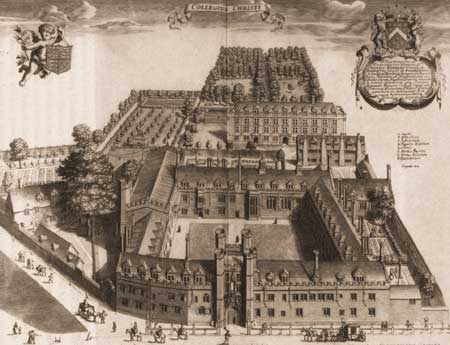
Christ's College, Cambridge: a 17th century Puritan stronghold, where Milton spent his university years.When Milton studied at Cambridge, his college, Christ’s, was a stronghold of Puritanism. Some of the fellows (i.e. tutors and lecturers) of the college were reprimanded by the university authorities for attacking various practices of worship used in the college chapel, and for speaking to each other in English instead of Latin. As the seventeenth century went on, Puritans became concerned with the way the Church of England, particularly under Archbishop William Laud, was shifting back towards ritual and ceremonial practices found in the Catholic Church, and as a result downplayed the importance of preaching from the Bible.

The Puritans often suffered from a reputation of being excessively strict and unfailingly grim. Though various actions from Puritan leaders, such as Thomas Cromwell’s attack on the theatre, did nothing to lighten this reputation, many Puritans lived out their faith in a joyful way, valuing the natural world and the arts alongside their religion. Milton’s Puritanism is aligned with this latter kind - he wrote some of his poems to be set to music and helped to put on shows for the nobility. The unifying aspect of Puritanism is the belief that ordinary people were important and deserved to be educated in order to understand God’s message to them.

At the time of the English Civil War, Puritanism was generally associated with the Parliamentarian side, and Laudianism (the principles of Archbishop Laud) with King Charles’ supporters. These religious disagreements contributed to the mix of tensions leading to the wars. When Parliament won the war and set up a republic, various Puritan groups had an input into political decision-making.

Puritan factionalism is one possible explanation for why the republican government did not hold onto power. There was a wide spectrum of different religious groups in the broader Puritan movement, some more extreme than others, but the distinction which is most significant for thinking about Milton is the distinction between Presbyterians and Independents. The Presbyterians wanted to keep a national church, but to have it led by a council of ministers (presbyters) who had equal status to each other (unlike the layered hierarchy of the Catholic church). The Independents wanted each specific congregation to be able to decide for itself its beliefs and practices. Milton seems to have moved from working with the Presbyterians against the bishops, to being disillusioned with the Presbyterian desire to bring in a new system of religious control. His sympathies generally leaned towards the Independent side.

Milton's Own Beliefs

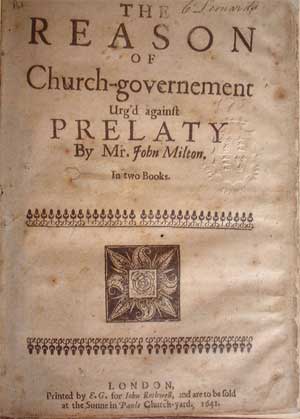
It’s hard to determine Milton’s exact beliefs, except to say that he was a strong Protestant who emphasised the freedom of the individual. When he was a young man, Milton was preparing to become a clergyman in the Church of England as his parents had intended. However, he later decided that because ‘tyranny had invaded the Church’ he could not be ordained in the Church of England with a good conscience (The Reason of Church-GovernmentWorks, p.65).  It is fair to say that Milton probably held a number of controversial beliefs, evidenced by his writings, some of which included:

  • The idea that the soul dies with the body and will be resurrected with the body on the Day of Judgement. 

  • A belief in divorce on the grounds of incompatibility, not just adultery. This can be found in The Doctrine and Discipline of Divorce (1643), the first of Milton’s four divorce tracts.

  • Sympathies with Arminianism, a new variant of Protestant theology, which, in contrast with mainstream Calvinism, emphasised human freedom rather than God’s ruling power over all things.

  • Heretical and unorthodox views on the Trinity: instead of the standard Christian belief that God is one God in three persons – Father, Son and Holy Spirit – Milton seems to have believed that these were three separate beings, and that the Son and Spirit were not equal with the Father. Typically this belief is called Homoiousianism. These ideas are found in a theological work traditionally attributed to Milton, De Doctrina Christiana (meaning ‘On Christian Teaching’), although there is currently some debate over whether Milton wrote it.

These debates about Milton’s theological beliefs influence how we read Paradise Lost, where, for example, it may appear that the Son is a being who is greater than the angels but not strictly equal to God the Father. Paradise Lost was written after the Restoration of Charles II in 1660, who returned the Church of England to how it was in his father’s time before the Civil War. It seemed as if the Puritan cause had been defeated. We might see Abdiel in Books V and VI of Paradise Lost as representing this isolated Puritan force, standing for purity and truth in the midst of a corrupt society. In Book V, lines 809-48, Abdiel defends a radical obedience to God with ‘zeal’, even though his manner seems ‘out of season’ and ‘singular and rash’ (V.849-51). Many Puritans seemed this way to the people around them. It seems that Milton became increasingly isolated, politically and religiously, in his later life. Perhaps he saw himself as an Abdiel figure: ‘Among the faithless, faithful only he’ (V.897).

Suggested further reading