If thou beest he; but oh how fallen! how changed
From him, who in the happy realms of light
Clothed with transcendent brightness didst outshine
Myriads though bright… (1.84-7)
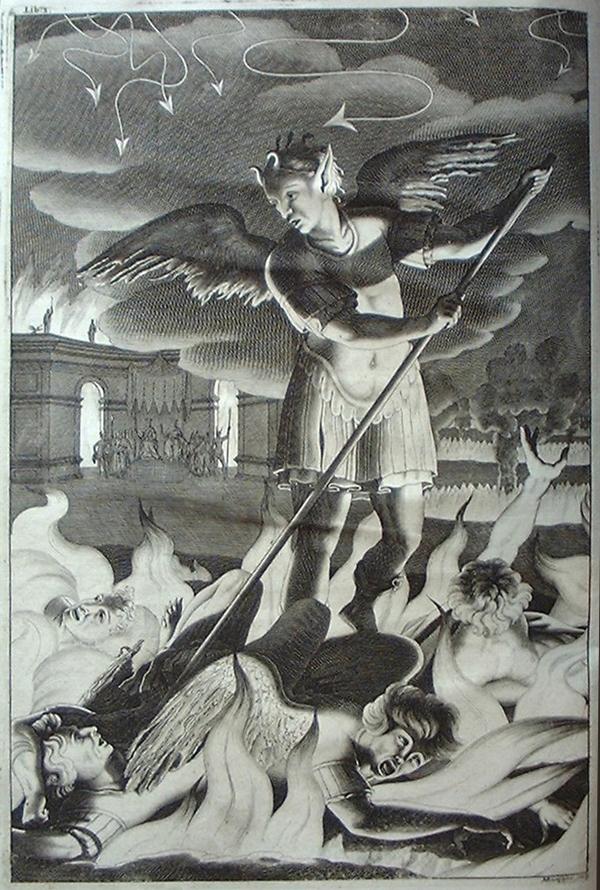
Satan’s first speech in Paradise Lost—the first by any character, which ‘Break[s] the horrid silence’ in which the poem begins (1.83)—is delivered when he comes to, after his fall, on the burning lake of Hell. He can hardly recognise his co-conspirator Beelzebub, so ‘changed’ is he from his former glory. Satan self-corrects to ‘how changed’ from the more morally loaded, thus more accurate exclamation ‘how fallen!’, in an attempt to avoid (we sense) the moral and spiritual implications of the Fall, for himself especially. His broken syntax evokes a contorted psychology, conveying both despair at change and denial of it, overwhelming recognition and lack thereof, competing for prominence in the first line.
These first words contain a double allusion, one biblical and one classical: to Isaiah 14:12, ‘How art thou fallen from heaven, O Lucifer’, and Virgil’s Aeneid 2.274, Aeneas’s horrified recognition of Hector’s ghost, ‘ei mihi, qualis erat! quantum mutatus ab illo / Hectore qui…’ (‘Ah me, what aspect was his! How changed he was from that Hector, who…’). This deepens our observation about ‘how fallen’ vs. ‘how changed’: Satan’s corrective allusion to pagan epic serves as a self-heroizing diversion from the darker implications of the biblical verse. As Colin Burrow explains,
[the] priority [of the biblical text] gives a powerful irony to Satan’s words. … Layering the voice of the prophet Isaiah over those reverberating echoes of classical texts [this moment in Virgil being based on Ennius’s meeting with the ghost of Homer] suggests that it is the prophet rather than Satan himself who really knows what is going on in this scene. Satan’s echo of Virgil seems like an afterthought, an attempt to cover over his biblical fall with epic allusions.
The following lines claw back some power and ego for their speaker by braggingly recollecting Beelzebub’s former superiority ‘in the happy realms of light’ (exceeded, we recognise, only by Satan’s own). This passage sets the tone for Satan’s speeches throughout the poem, especially with its quibbling concessions and denials, the ifs and thoughs which echo through the rest of the speech: ‘[nor] do I repent or change, / Though chang’d’ (1.96-7). Satan is a figure who sees the reality of his position all too well but will do anything to talk himself out of it, always persuading himself, primarily, as he convinces others, in a way that strikes us as distinctly modern.