Image
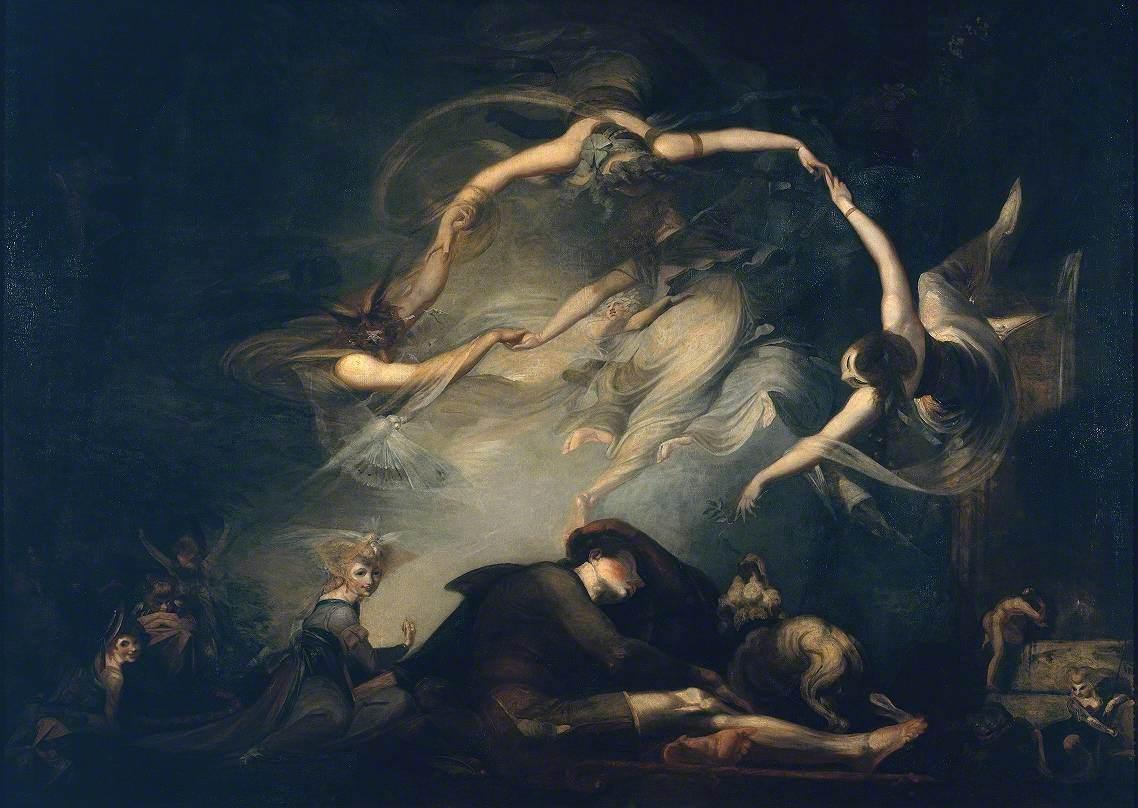
Henry Fuseli, 'The Shepherd’s Dream, from "Paradise Lost"' (1793)

'Behold a wonder!': A Miltonic Simile

Behold a wonder! they but now who seemed 
In bigness to surpass Earth’s giant sons
Now less than smallest dwarfs, in narrow room
Throng numberless, like that pygmean race
Beyond the Indian mount, or faerie elves,[i]
Whose midnight revels, by a forest side
Or fountain some belated peasant sees,
Or[ii] dreams he sees, while overhead the moon
Sits arbitress, and nearer to the earth
Wheels her pale course, they on their mirth and dance
Intent, with jocund music charm his ear; 
At once with joy and fear his heart rebounds.[iii]
Thus incorporeal spirits to smallest forms 
Reduced their shapes immense, and were at large, 
Though without number still amidst the hall
Of that infernal court. (1.777-92)


[i] Pygmies are a race of very small people mentioned in ancient history and literature, said to inhabit parts of Ethiopia or India—as Milton suggests here (‘Beyond the Indian mount’), immediately transporting the reader to a far-flung, exotic place in the early modern imagination. Milton’s alternative comparison, ‘faerie elves’, on the other hand, has a more home-spun, British folkloric feel, suggestive of Edmund Spenser’s Faerie Queene or Shakespeare’s Midsummer Night’s Dream.

[ii] This is the third ‘or’ in four lines. ‘Or’ is an important word in Paradise Lost’s creation of a ‘poetics of incertitude’ whereby the reader is presented with a series of suspended, morally significant choices by the poet (see Peter C. Herman, ‘"Paradise Lost", the Miltonic "Or," and the Poetics of Incertitude’, https://www.jstor.org/stable/4625063). Here, the effect is dreamlike and disorienting.

[iii] The peasant’s feeling of ‘joy and fear’ is a sign that this simile has taken us far away from the metamorphosis of the devils in hell. The shrinking of the devils is an image that ought to inspire derision, not delight and joy. The peasant’s ‘joy and fear’ (coupled with the sense of scale provided by the moon) is suggestive of the feeling of the sublime which many readers have encountered in Paradise Lost.
This ‘epic simile’ describes the wondrous shrinking of the devils—Satan’s companions in hell—from the size of giants to that of dwarves. It comes at the end of book 1 of Paradise Lost, after the fallen angels have built their ‘high capital’ Pandaemonium (1.756). The devils are gathering for the council which will begin book 2.

There are many well-known similes in Paradise Lost, and this is one of two very famous ones concerning scale and featuring the moon in book 1—the other being the description of Satan’s shield as ‘like the moon, whose orb / Through optic glass the Tuscan Artist [Galileo] views … to descry new lands, / Rivers or mountains in her spotty globe’ (1.287-91).

This simile brings our mind’s eye on a comparable journey of perspective and scale. Milton’s poetry takes off in a flight of fancy that directs our attention far away from the metamorphosis of the devils in hell. The ‘wonder’ of these lines is not merely the shrinking of the devils but the other poetic, spatial, temporal and moral perspectives the simile opens up, suggesting alternatives to the devils’ limited horizons.

Keep scrolling for three key literary effects in these lines

1. An epic simile is an extended simile of several lines—in this case, nine lines, extending from ‘like that pygmean race’ to ‘Thus…’—which is typical of poetry in the epic tradition from the ancient Greek poet Homer onwards. Similes are made up of a tenor—the thing being described, in this case the shrunken devils—and a vehicle—the thing being compared to the tenor, in this case pygmies or elves. In epic similes, where the vehicle is described at some length, it is common for the vehicle to seem unlike the tenor in many ways, as well as like it—for there to be as many points of difference as similarity, challenging the reader to think actively about how to see the tenor. Epic similes also typically transport the reader away from the scene at hand into an alternative world of possibilities—in the case of Homeric similes, often away from the action of war to a world of peacetime activity; in the Galileo simile, from hell in the ancient biblical past to the landscapes of the moon newly discovered in Milton’s own time. Milton’s simile gives us a pastoral scene in the midst of epic, but also one of demonic ‘faerie’ energy rather than tranquillity.

This Miltonic simile is unusual, though, in its focus on two figures which have no equivalent in the world of the devils—the peasant and the moon. The only corresponding figure for the belated peasant in the narrative is the reader who likewise ‘sees / Or dreams he sees’ the devils’ transformation. The function of the moon is to provide a further sense of scale, to make us see the pygmy-like devils from the increased distance of the moon wheeling its course, rather than the peasant, shrinking them even further—similarly to the simile of the moon through the telescope describing Satan’s shield, which had the effect of scaling something ‘massy, large and round’ down to seem simultaneously small and diminished in the lens of the telescope. The moon also takes us out of hell, to the furthest flung reaches of our world (‘Beyond the Indian mount’), to a wider view of the universe, suggesting the profoundly limited purview of the devils’ ‘narrow room’ in hell.

Milton’s epic similes are moments of particularly close, often combative encounter with his classical predecessors, where the poet asserts his affiliation but also difference and even superiority of his biblical epic to the classical tradition.

2. The presence of the moon in the simile seems also to be motivated by a classical allusion in this passage. Paradise Lost is full of such allusions, which often complicate the sense of Milton’s lines.

‘…sees / Or dreams he sees’—the peasant may not actually see this scene at all, but might only be dreaming it up. In Virgil’s Aeneid, one of Paradise Lost’s major predecessors in the epic tradition, the hero Aeneas recognises his spurned ex-lover Dido on a visit to the Underworld, the classical equivalent of Satan’s hell, like one who ‘sees or fancies he has seen the moon rise amid the clouds’ (‘aut videt aut vidisse putat per nubila lunam’, Aeneid 6.454. ). In Milton’s simile, the moon is no longer the tenor but has been displaced to the position of remote ‘arbitress’ of the skies above the scene. This allusion to a pathetic and affecting moment in classical literature contributes to our sense that the poetry of these lines exceeds their apparent function in Milton’s narrative, imbuing the belated peasant’s vision with a seemingly inappropriate emotive charge.

Why is the peasant ‘belated’, anyway? This word seems to capture something about the poetics of Paradise Lost far beyond this moment. The epic poet writes elsewhere in about his fears that living in ‘an age too late’ might dampen and depress the height of his poetic aspirations (9.44-6). The OED gives this instance of ‘belated’ as an example of the meaning ‘Overtaken by lateness of the night … benighted’: the peasant is out late at night, and perhaps also in a state of intellectual darkness. But he is perhaps also belated in the other sense in which Milton uses the word: ‘too late; out of date’. He is belated as a peasant—as a figure of an old, pastoral world; he is also belated, as the poet is, as a fallen man, and in relation to the biblical and classical matter of the poem. The simile, with all its vast distances, alternatives and uncertain viewpoints, seems to speak to the impossible but attempted task of the poet to describe subjects so vast, remote, and un-visualisable to man—often with reference to classical but fallen equivalents. 

3. Several well-known readers, critics, and even artists have commented on this simile. For the critic Geoffrey Hartman, the arbitrating moon is the culmination of a ‘series of images in which the poet constantly suggests, destroys and recreates the idea of an imperturbably transcendent discrimination’—that of God, the supreme arbiter. This series of images, tending towards the imperturbable power of God’s creation, serves as an implied ‘counterplot’ to the Satanic plot of the building of hell.

The French Enlightenment philosopher and writer Voltaire argued that this is not simply an epic simile but a mock-epic simile. ‘Methinks the true Criterion for discerning what is really ridiculous in an Epick Poem,’ he wrote, ‘is to examine if the same Thing would not fit exactly the Mock heroick. Then I dare say that nothing is so adapted to that ludicrous way of Writing, as the Metamorphosis of the Devils into Dwarfs.’ Mock-epic is a genre that parodies and trivialises epic’s grand concerns by playing with scale and making them small. Mock-epic existed before Paradise Lost, but Milton’s strong influence on the epic tradition and his distinctive style inspired a profusion of mock-epics in the century after Paradise Lost, including Alexander Pope’s Rape of the Lock, which parodied the grand scale of Milton’s poem specifically. However, as Voltaire notes, Paradise Lost already contains such moments. It would be reductive, though, to call this a purely mock-epic moment, given that its poetic energies seem to lie elsewhere than in the devils’ ludicrous shrinkage.

The pun on ‘at large’ at the end of this passage does seem to take us from the sublime to the ridiculous, however. The critic Christopher Ricks describes this pun as ‘superbly contemptuous’ towards the shrunken devils. Readers have not always appreciated the audacity and indecorousness of some of Milton’s language: the eighteenth-century editor Richard Bentley found the ambiguity of the phrase ‘at large’ ‘shocking at first reading’, reflecting his wider anxieties about Milton’s flouting of norms of language and imagery.

‘The Shepherd’s Dream’ is one of forty moments from Paradise Lost chosen for visual realisation by the painter Henry Fuseli in his 1791-99 series. Fuseli’s painting shows a range of fairies crouching and dancing in an aerial circle, with the figure of the shepherd asleep in the foreground; his sheepdog looks up, suggesting that the shepherd’s vision is both a dream and somehow real. The moon isn’t depicted, but her ‘pale’ light is suggested in the centre of the fairy formation. This painting again suggests that this simile’s poetic energy lies rather in the shepherd’s dream than in the devils’ diminution.

Many readers and artists have been especially drawn to those Miltonic moments that are hardest to visualise—like ‘darkness visible’ itself.

Works Cited

Geoffrey Hartman, ‘Milton’s Counterplot’, https://doi.org/10.2307/2871892.

Peter C. Herman, ‘"Paradise Lost", the Miltonic "Or," and the Poetics of Incertitude’, https://www.jstor.org/stable/4625063

Alexander Pope, The Rape of the Lock, https://www.poetryfoundation.org/poems/44906/the-rape-of-the-lock-canto-1.

Christopher Ricks, Milton’s Grand Style (Oxford, 1963) (quotation on p. 15).