Behold a wonder! they but now who seemed
In bigness to surpass Earth’s giant sons
Now less than smallest dwarfs, in narrow room
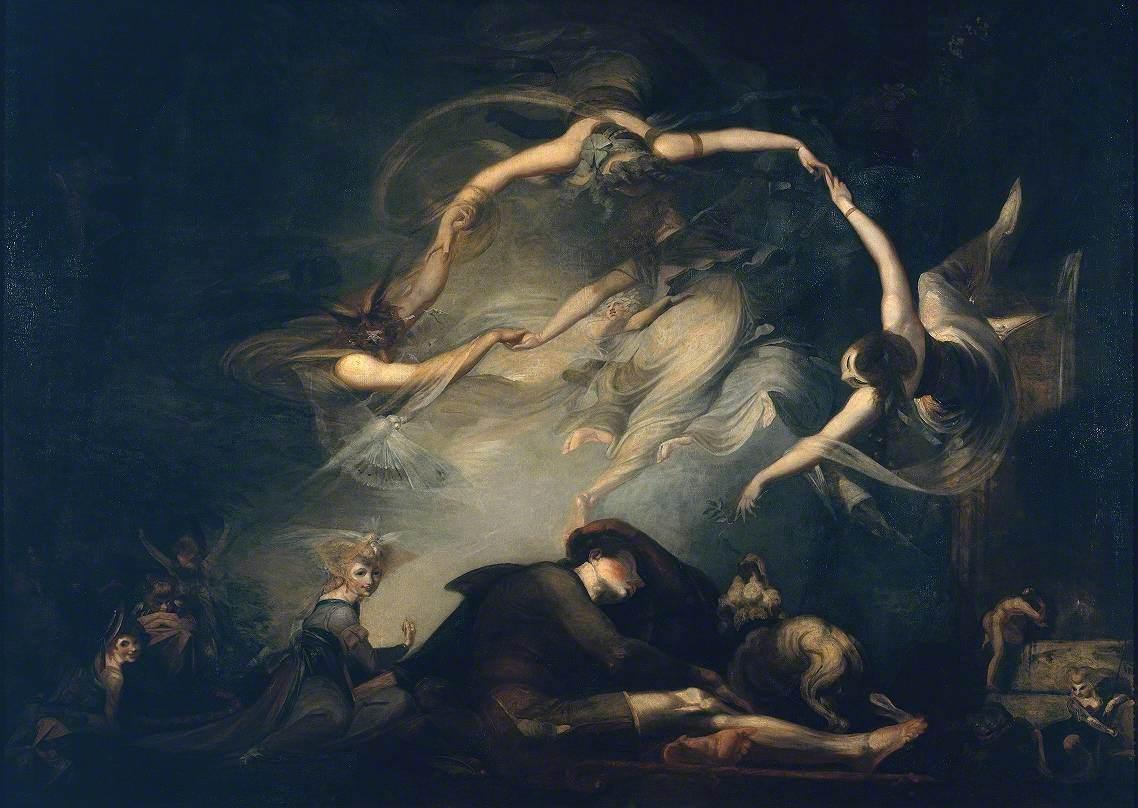
Throng numberless, like that pygmean race
Beyond the Indian mount, or faerie elves,[i]
Whose midnight revels, by a forest side
Or fountain some belated peasant sees,
Or[ii] dreams he sees, while overhead the moon
Sits arbitress, and nearer to the earth
Wheels her pale course, they on their mirth and dance
Intent, with jocund music charm his ear;
At once with joy and fear his heart rebounds.[iii]
Thus incorporeal spirits to smallest forms
Reduced their shapes immense, and were at large,
Though without number still amidst the hall
Of that infernal court. (1.777-92)
[i] Pygmies are a race of very small people mentioned in ancient history and literature, said to inhabit parts of Ethiopia or India—as Milton suggests here (‘Beyond the Indian mount’), immediately transporting the reader to a far-flung, exotic place in the early modern imagination. Milton’s alternative comparison, ‘faerie elves’, on the other hand, has a more home-spun, British folkloric feel, suggestive of Edmund Spenser’s Faerie Queene or Shakespeare’s Midsummer Night’s Dream.
[ii] This is the third ‘or’ in four lines. ‘Or’ is an important word in Paradise Lost’s creation of a ‘poetics of incertitude’ whereby the reader is presented with a series of suspended, morally significant choices by the poet (see Peter C. Herman, ‘"Paradise Lost", the Miltonic "Or," and the Poetics of Incertitude’, https://www.jstor.org/stable/4625063). Here, the effect is dreamlike and disorienting.
[iii] The peasant’s feeling of ‘joy and fear’ is a sign that this simile has taken us far away from the metamorphosis of the devils in hell. The shrinking of the devils is an image that ought to inspire derision, not delight and joy. The peasant’s ‘joy and fear’ (coupled with the sense of scale provided by the moon) is suggestive of the feeling of the sublime which many readers have encountered in Paradise Lost.