Under Elizabeth’s rule, many Protestant leaders returned to England. But while the country was Protestant in name, the national Church still attempted to include as many Christians as possible in order to hold the country together after so many years of religious divisions. Because of this, the Church of England signed up to a Protestant theology, but many of the outward features of the old church stayed the same – such as bishops, ministers wearing robes, and using a written service book. For some, these things could be used perfectly well in a Protestant context, but others thought that because they couldn’t find these things in the Bible, they shouldn’t be used at all. These people became known as Puritans. Church historian Patrick Collinson has called the Puritans ‘hot Protestants’, meaning people who were keen to reform the Church of England further to be more extremely Protestant.
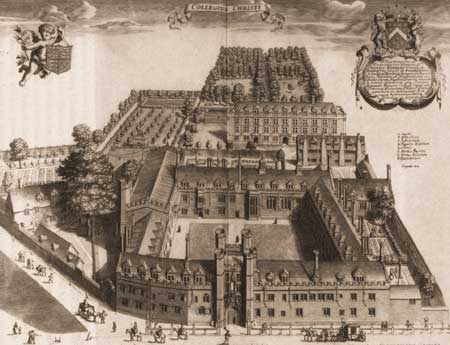 When Milton studied at Cambridge, his college, Christ’s, was a stronghold of Puritanism. Some of the fellows (i.e. tutors and lecturers) of the college were reprimanded by the university authorities for attacking various practices of worship used in the college chapel, and for speaking to each other in English instead of Latin. As the seventeenth century went on, Puritans became concerned with the way the Church of England, particularly under Archbishop William Laud, was shifting back towards ritual and ceremonial practices found in the Catholic Church, and as a result downplayed the importance of preaching from the Bible.
The Puritans often suffered from a reputation of being excessively strict and unfailingly grim. Though various actions from Puritan leaders, such as Thomas Cromwell’s attack on the theatre, did nothing to lighten this reputation, many Puritans lived out their faith in a joyful way, valuing the natural world and the arts alongside their religion. Milton’s Puritanism is aligned with this latter kind - he wrote some of his poems to be set to music and helped to put on shows for the nobility. The unifying aspect of Puritanism is the belief that ordinary people were important and deserved to be educated in order to understand God’s message to them.
At the time of the English Civil War, Puritanism was generally associated with the Parliamentarian side, and Laudianism (the principles of Archbishop Laud) with King Charles’ supporters. These religious disagreements contributed to the mix of tensions leading to the wars. When Parliament won the war and set up a republic, various Puritan groups had an input into political decision-making.
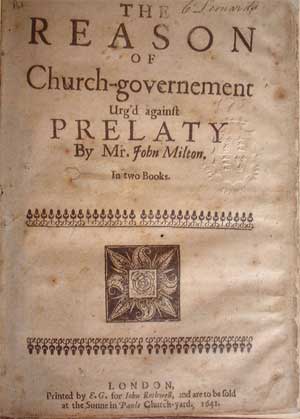
Puritan factionalism is one possible explanation for why the republican government did not hold onto power. There was a wide spectrum of different religious groups in the broader Puritan movement, some more extreme than others, but the distinction which is most significant for thinking about Milton is the distinction between Presbyterians and Independents. The Presbyterians wanted to keep a national church, but to have it led by a council of ministers (presbyters) who had equal status to each other (unlike the layered hierarchy of the Catholic church). The Independents wanted each specific congregation to be able to decide for itself its beliefs and practices. Milton seems to have moved from working with the Presbyterians against the bishops, to being disillusioned with the Presbyterian desire to bring in a new system of religious control. His sympathies generally leaned towards the Independent side.

 In October 1656, the Quaker leader James Nayler rode into Bristol on a donkey, imitating Jesus Christ’s entry into Jerusalem. Women surrounded Nayler, laying palm leaves in front of him. This incident was debated in parliament for six weeks, with many MPs arguing that Nayler should be put to death for blasphemy. In the end, a more lenient punishment was decided upon, and Nayler had his tongue drilled through.