30.09.26
In our latest blog post, Orlando Reade, author of What in Me Is Dark: The Revolutionary Life of Paradise Lost, considers whether he does in fact sympathise with Satan, as some of his reviewers have claimed.

Being accused of loving Satan is a risk for anyone writing about Paradise Lost but I didn’t realise it would happen to me. Then, a review of my book said: “Reade seems to sympathize with Satan.” I didn’t think this was true. But then I started to wonder: had I taken a position on the all-important critical question facing the reader of Paradise Lost? Had I sided with the prince of darkness?
Milton’s epic opens in Hell, where Satan is waking up after being driven out of Heaven. Satan describes his enemy, the distant and seemingly cruel God, as
our grand foe,
Who now triumphs, and in the excess of joy
Sole reigning holds the tyranny of heaven. (1.122-24)
Anyone who knows anything about the poem’s author will recognise that the archfiend sounds a little like John Milton, who spent much of his adult life raging against tyrants. The first two of the poem’s twelve books, we spend almost entirely in the company of Satan and his followers. It’s only in Book 3 that we encounter God, and even then, He seems a bit irritable, self-justifying, and somewhat wooden as a character. For all these reasons, many people have wondered if we are supposed to sympathise with Satan.
One of the earliest recorded responses to Paradise Lost notices this. In 1670, an Anglican priest called John Beale, remarked that the poem was full of “long blasphemies of Devils.” Beale was unsurprised, since he associated the poet with the demonic position of having supported Parliament in England’s all-too-recent Civil War. For the next century, many other readers saw Milton’s poem as shaped by his own politics, but few believed Satan was the intended hero.
This changed amid the political ferment of the late eighteenth century. In Olaudah Equiano’s Interesting Narrative (1789), the anti-slavery campaigner tells of his birth and childhood in West Africa, and then his capture and transportation to America. Equiano echoes Paradise Lost three times, and in one place seems to compare enslaved people with that of the fallen angels in Hell (who are God’s “thralls” or slaves). Sailing towards the Caribbean island of Montserrat, where slavery was especially brutal, Equiano quotes Milton’s description of Hell:
Regions of sorrow, doleful shades, where peace
And rest can never dwell, hope never comes
That comes to all; but torture without end
Still urges
The scholar Mary Nyquist plausibly suggests that this was the origins of a modern interpretation that treats Satan as more sympathetic than Milton’s God. A few years later, another reader would make this even more explicit.
William Blake’s Marriage of Heaven and Hell (1792) is the origin of what has become known as the “Satanist” reading of Paradise Lost. The book is a collection of spiritual paradoxes, written under the influence of the philosopher Swedenborg, and the thought about Paradise Lost is suitably paradoxical. Blake says that Milton wrote “in shackles” when he described God and the angels, but free when he wrote of God’s imprisoned slave, Satan. Because of this, Blake claimed, Milton was “of the devils [sic] party without knowing it.”
In the twentieth century, Milton’s Satan inspired other brilliant and surprising interpretations. The Trotskyist historian C.L.R. James identified Satan with Cromwell, arguing that Milton came to regret his work on behalf of the new government when Cromwell set himself up as a tyrant (James was likely thinking of his own efforts to distance himself from Stalinism). A few years later, Malcolm X associated Milton’s archfiend with Western colonialism and white supremacy. An influential academic objection to Blake came from C.S. Lewis. In his Preface to Paradise Lost (1942), Lewis argued that Milton’s Satan undergoes a “progressive degradation,” beginning as a hero and ending up as the unambiguous villain.
In the 60s, Satan took on a counter-cultural allure. The Church of Satan in California was set up by men who read Paradise Lost, and Hunter S. Thomson quoted Milton in his book about the Hells Angels, a biker gang apparently named after Paradise Lost. Blake’s reading received powerful support from the iconoclastic critic William Empson (who was thrown out of Cambridge after contraceptives were found in his room). In Milton’s God (1961), Empson compares the deity in Paradise Lost to “Joe Stalin.” Likewise, Empson claims that Satan really believes that his temptation of Adam and Eve is a sincere invitation: come live with me in Hell rather than suffer the tyranny of God in Heaven!
Empson recognises that this reading breaks down later in the poem, where Satan becomes more obviously Satanic. This happens to be where my own Satanism begins. In Book 10, after he has successfully tempted Eve and Adam, Satan returns to Hell to tell his followers what he’s done. He expects a hero’s welcome but is disappointed: they have all been turned into snakes. What’s more fallen angels are forced to annually eat from a tree in Hell, whose fruit turns into ashes in their mouths. This is the culmination of what Satan’s degradation – from the sublime hero of Book 1 to the cartoonish snake of Book 10.
Satan’s punishment belongs to a pre-modern style of punishment: in the seventeenth century, people were still being put in the stocks, pelted with fruit, branded on their faces, and executed publicly. The nineteenth century saw liberal reforms, who replaced shame with moral correction. In the twenty-first century, even those guilty of the most extreme crimes are granted human rights. Of course, many people today still enjoy witnessing the suffering of people deemed to be guilty, but I suspect that the majority of modern readers don’t find this moment in the poem as satisfying as Milton intended.
That doesn’t, of course, mean we should side with Satan. Blake’s remark does illuminate something true about Milton’s epic: the descriptions of Hell in Books 1 and 2 abound with extraordinary similes and rhetorical brilliance (many of the most famous lines are Satan’s) and you’d be justified in saying these are the best books of poetry. The same has been said of Dante’s Inferno: that it is more interesting than Purgatorio or even Paradiso. It might simply be the case that Hell is a more fertile subject for poetry than Heaven.
The most important reason not to accept the Satanist interpretation, however, is that it prevents you from enjoying the last three books of Paradise Lost, where Adam and Eve prepare to leave Eden, to understand their new mortality, and learn to forgive each other. The final lines of the poem are, to my mind, some of the most beautiful in the English language, and they are difficult to enjoy if you believe the poem’s moral cosmology is upside down.
A few years after Empson’s controversial book, Stanley Fish discovered a way to reconcile Blake’s insight with the poet’s religion. In Surprised by Sin (1971), Fish argued that Milton’s poem set traps for the reader, tempting us to believe Satan only to show us the error of our ways. To teach the reader to fish, as it were. This ingenious argument goes some way to explaining why Satan is so sympathetic, without making Milton consciously or unconsciously demonic. However, Paradise Lost is not a systematic treatise (Milton wrote one of those), and we shouldn’t try to make it one.
Another way of thinking about Satan is as something analogous to the trompe l’oeil paintings popular in seventeenth-century Italy. Milton may have seen them on his travels as a younger man. As the scholar Susanna Berger describes in an important new study The Deformation, some of those illusions had a specific theological message, some of them are simply designed to astonish, and sometimes the astonishment is the message, reminding us that all human knowledge is imperfect. The same is surely true of Milton’s poem.
There is precedent for comparing poetic characters to illusions. Milton’s contemporary Thomas Hobbes did so in 1650, in an essay on William Davenant’s heroic poem Gondibert.
“I believe (Sir) you have seen a curious kind of perspective, where, he that looks through a short hollow pipe, upon a picture containing diverse figures, sees none of those that are there painted, but some one person made up of their partes, conveyed to the eye by the artificial cutting of a glass.”
Hobbes is saying that Davenant’s poem contains a kind of trick of the eye, a little like one that Hobbes knows that his friend Davenant has seen in real life. An illusionistic picture where, if you look at it through a tube, a group of small figures look like one big figure. (This is curiously similar to the famous image in Hobbes’s Leviathan, where the sovereign’s big body is made up of lots of small men.) Likewise, Hobbes says that Davenant’s characters are allegories of different virtues, which may be combined in one man.
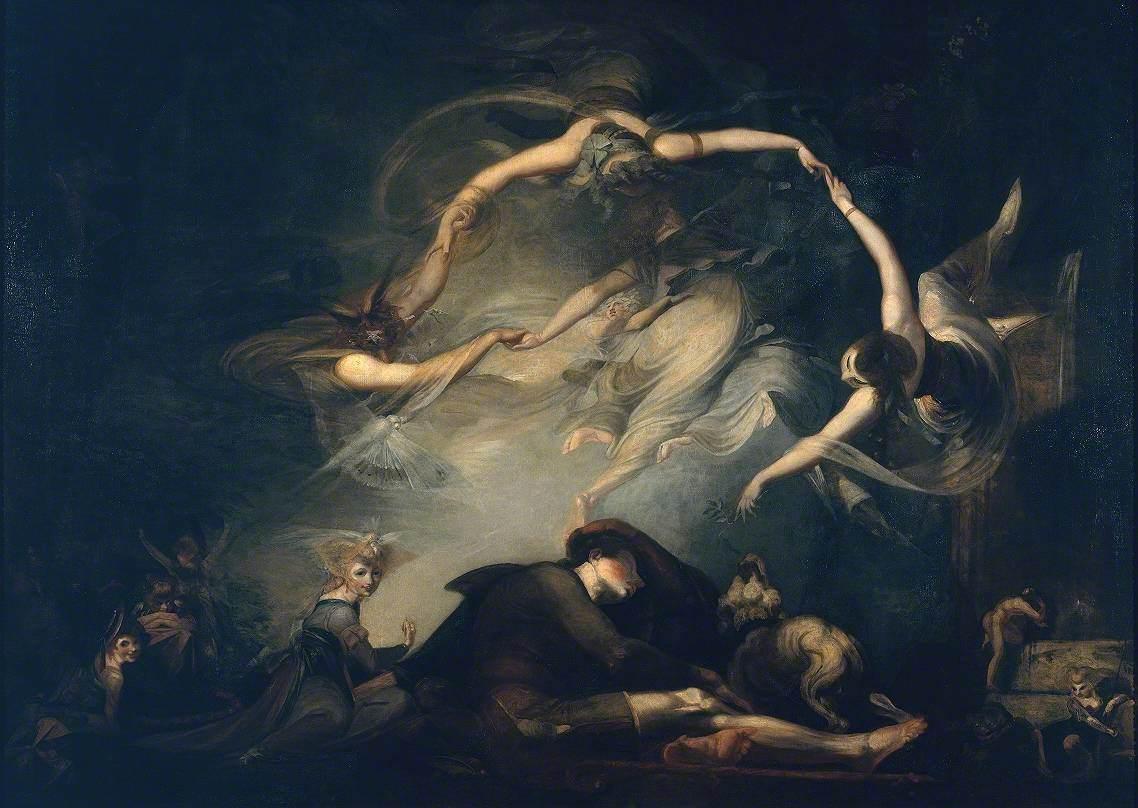
Milton’s Satan is the opposite, combining sins that readers have associated with many different historical figures – Milton himself, Cromwell, King Charles I, the Pope, the King of Spain etc. Perhaps we should treat Satan as an ingenious illusion rather than a character per se. Likewise, in an ingeniously complex simile, Milton compares the devils morphing into atoms so that they can fit into their Parliament building to
faerie elves,
Whose midnight revels, by a forest side
Or fountain some belated peasant sees,
Or dreams he sees, while over-head the moon
Sits arbitress, and nearer to the earth
Wheels her pale course, they on their mirth and dance
Intent, with jocund music charm his ear… (1.782-7)
The devils are like fairies dancing in some clearing of the forest, or an illusion as seen by a peasant, superstitious or drunk or tired, beneath the visiting moon. Not every seduction is a trap, however, and sometimes we may simply be astonished by this poem. But we must remain vigilant. To sympathise with Satan may be to overlook the poem’s moral thinking.
The word I most often use to describe Milton’s Satan is “kaleidoscopic.” As an angel, he is a shape shifter, and as a devil, he’s a deceiver, and he seems to ripple and glitter and glitch as you read. Satan is one of the most brilliant inventions in English literature, and the many different interpretations are a testament to this. Still, you sympathise with him at your peril.

Orlando Reade is the author of What in Me is Dark: The Revolutionary Life of Paradise Lost.