
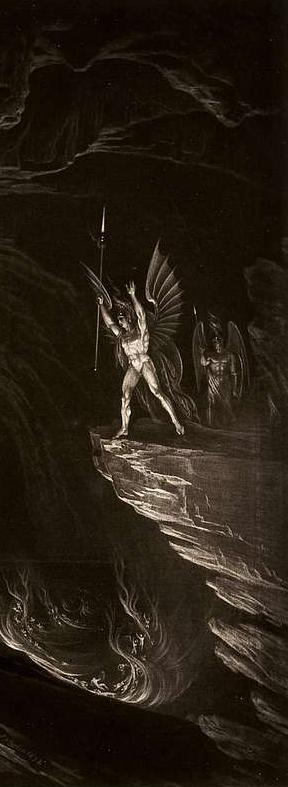
Nor did they not perceive the evil plight
In which they were, or the fierce pains not feel;
Yet to their general’s voice they soon obeyed
Innumerable. As when the potent rod
Of Amram’s son in Egypt’s evil day
Waved round the coast, up called a pitchy cloud
Of locusts, warping on the eastern wind,
That ore the realm of impious Pharaoh hung
Like night, and darkened all the land of Nile:
So numberless were those bad angels seen
Hovering on wing under the cope of hell
’Twixt upper, nether, and surrounding fires;
Till, as a signal giv’n, th’ uplifted spear
Of their great sultan waving to direct
Their course, in even balance down they light
On the firm brimstone, and fill all the plain
Comparing Satan to Moses seems heretical, almost blasphemous, yet Milton does so in this excerpt of Book 1 of Paradise Lost, where Satan first calls his legions after their fall from heaven. In this scene, the fallen angels, though in pain, obey Satan’s command and rise like the locusts in the eighth plague of the biblical Exodus, until at his signal they ‘light/ on the firm brimstone, and fill all the Plain’ (349-350). Here and elsewhere in Paradise Lost, Milton is intentionally misleading, creating a parallel to the Exodus only to subvert it. With this simile to the plagues on Egypt, he directs readers to connect Satan, director of the fallen angels, with Moses, director of the locusts. Yet the analogy crumbles once the syntax reveals the simile is not about Satan at all, but rather the number of demons. Milton uses this repeated technique of subverted expectations to show that although Satan may at first appear like a deliverer, he is a ‘General’ (337) and ‘Sultan’ (348), bringing violence instead of peace, and tyranny instead of salvation.
With his extended simile, Milton connects Satan to Moses, the deliverer of the Israelites from Egypt. Beginning with the word ‘As,’ he signals the start of a biblical comparison (338). Exodus 10 reads,
And Moses stretched forth his rod over the land of Egypt, and the Lord brought an east wind upon the land all that day, and all that night; and when it was morning, the east wind brought the locusts…For they covered the face of the whole earth, so that the land was darkened (King James Version, Ex. 10:13, 15).
Milton not only references the ‘rod,’ but places it at the end of line 338, emphasizing it through enjambment to help readers make the connection to this biblical passage. The enjambment also allows him to highlight Moses, or ‘Amram’s son,’ at the beginning of the next line (Ex. 6:20). Milton also references ‘Egypt’ (line 339), ‘Locusts’ (341), ‘Eastern Wind’ (341), and the ‘darken'd…Land of Nile’ (343), so that the comparison is inescapable. Since Moses summons the locusts and Satan summons the fallen angels, this leads readers to the conclusion that in this simile, Satan is Moses. Furthermore, Milton mentions ‘impious Pharaoh’ (342). If Moses here is Satan, and the locusts are fallen angels, then who could Pharaoh be except God himself? As Moses led the Israelites from Pharaoh, so Satan led the fallen angels from God. This implies that God, like Pharaoh, is a hard-hearted slave master. Thus Milton makes this analogy not only to suggest that Satan can be seen as a liberator, but that he may even be a savior from an enslaving God.
Just as readers are becoming uncomfortable, the sentence reveals misleading syntax and turns out to be about the locusts all along. Thus, the comparison is to the fallen angels, and not to Satan at all. The ‘as…so’ construction starts with ‘Amram’s son,’ leading readers to assume the comparison is between Moses and Satan (338-339). However, when the ‘so’ finally comes five lines later, it is to say ‘so numberless’ (344). Since ‘numberless’ describes the sheer volume of fallen angels filling the sky, it follows that the simile is about them. In other words, ‘As were the droves of locusts in the eighth plague on Egypt, so many were the fallen angels.’ Moses and Satan are grammatically irrelevant; this comparison is purportedly just about the number of fallen angels. Milton allows the reader to think, for six lines, that he is comparing Satan to Moses, but he is not. Rather, he uses the overturned assumptions to imply that, like the simile itself, Satan is not as he seems.
Far from describing Satan like Moses throughout, Milton calls him a ‘General’ (337) and ‘Sultan’ (348), emphasizing that he is not a savior. The OED defines a sultan as ‘The sovereign or chief ruler of a Muslim country’ (‘Sultan n.’ 1a). As a staunch Christian in a time of extreme religious animosity, Milton would have used an association with Islam negatively, emphasizing that Satan is an un-Christian and immoral ruler. A further definition, contemporary to Milton’s writing, also defines ‘sultan’ as a despot or tyrant, which entirely undermines the image of Satan as an altruistic savior and champion of liberty (‘Sultan n.’ 2). Likewise, the word ‘general’ is entwined with war, suggesting that Satan brings not peace, but chaos and conflict. His ‘rod’ is actually an ‘uplifted Spear,’ indicating that he doesn’t desire salvation, but violence (347). Even the very simile that initially appears to compare Satan to Moses breaks down, as Satan isn’t leading the Israelites in this vision, he’s summoning locusts. Rather than caring for God’s people, he is focused on destruction, making him a twisted image of Moses. While Satan’s only connection to Moses is perverted and theoretical, coming from the simile, Milton directly uses the words ‘general’ and ‘sultan’ to show his true identity: a destructive and violent tyrant.
Milton is not connecting Satan to Moses here, but rather arguing that while Satan may seem like a deliverer, he is not. Milton suggests Satan as a type of Moses only to break down the same argument and leave room for another. Familiar with the Christian doctrine that sees Moses as a forerunner to Jesus, the better prophet and deliverer, Milton uses this comparison of Satan to Moses to show the way Satan seems to offer salvation, but falls short of what only Jesus can offer. As Satan’s comparison to Moses falls apart, it calls to mind Hebrews 3:1-3:
Consider the Apostle and High Priest of our profession, Christ Jesus; Who was faithful to him that appointed him, as also Moses was faithful in all his house. For this man was counted worthy of more glory than Moses, inasmuch as he who hath builded the house hath more honour than the house.
To Milton, Jesus is, and always has been, the true and better Moses.