Edward Allen
Twenty-five years or so ago, with the dawning of a new millennium, a prominent figure in the British imagination was going through an identity crisis. The name? Bond, James Bond. Pierce Brosnan’s tenure as 007 had produced decidedly mixed reviews, and the last film to feature him in the title role, Die Another Day (2002), would confirm what many viewers had sensed in 1999 when The World is Not Enough had darkened cinema screens: enough’s enough; time for a reboot. Meanwhile, some competitors were beginning to emerge. Matt Damon’s Jason Bourne – a man to rarely crack a smile, let alone a joke – appeared in 2002, and did so with the air of someone who wanted to make the genre new. A little closer home – to Bond’s home, at any rate – was a TV series called Spooks. True, the writers of this series could only fantasise about the kind of funding that would turn The Bourne Identity into a franchise; but dreaming on a budget can produce interesting results, as British spies know only too well:
'I won’t know what to say! I’ll be too nervous. Sometimes I blush.’
‘Good. He’ll think you’re nervous at seeing him again.’
‘Celestial rosy-red, love’s proper hue. [sniffs] Paradise Lost. Milton! thou shouldst be living at this hour.’
‘All right, thanks for sharing that, Malcolm…’[1]
After 38 episodes, you might think the employees of Section D had little to reveal about themselves that we didn’t already know. Not a chance. Come season 5 (episode 3), a thermobaric bomb is understood to have entered the marketplace, and the team at MI5 has got to act fast in order to intercept it, or, failing that, to infiltrate the interested terrorist cell. Malcolm and Ros, two officers at Section D, dedicate themselves to preparing an old-style ‘honey trap’, the better to exploit or turn one of the cell’s members. The ill-fated bait is Leigh, who thinks she’s going to blush when she sees the man in question: ‘I won’t know what to say!’ Fortunately, Malcolm usually does; there are few things he can’t explain with a blueprint or a data bank. But on this occasion his saying blossoms beautifully, surprisingly, into literary quotation. Not that Leigh seems to care very much – nor does Ros for that matter – yet for a moment, just for a moment, you sense that something strange is afoot. For a second or two, Section D’s resident computer whizz has the look of someone who’s disappeared, gone elsewhere, touched by a different source and sort of intelligence. Stranger still, this doesn’t feel like a serious shift in tone. In a weird and very particular way, you might say, the drama has become a more spirited version of itself. Just for a moment, yes, it’s as though Spooks has been subtly spooked.
It is good to know that analysts as sophisticated as Malcolm can sometimes do without their clouds and memory sticks. But what does it mean to recall Paradise Lost, and for him to do so at this moment? The complicated thing about his lyrical turn has to do with the double reference. With no visual means of signalling his speech act – air quotes would interfere with the task at hand (wiring Leigh’s coat with a covert listening device) – Malcolm’s allusive behaviour sounds exactly that: ludic, playful, off-the-cuff. And this does something to disguise the fact that he’s not only remembering Book 8 of Paradise Lost; he’s also remembering Wordsworth remembering Milton. The point – too trivial to ponder in the middle of an op – is that they’ve been here before, and so have we. Not in Thames House, perhaps, but in a state of alarm, anguish, anticipation, just as Wordsworth sensed in 1802 upon returning home from post-revolutionary France. ‘Milton! thou shouldst be living at this hour’, he cries in ‘London, 1802’; Malcolm all but murmurs the line, but it feels no less urgent for that, and its meaning carries. Milton, just for a moment, is more than a point of reference. He is a presence.
As his allusion to Wordsworth makes plain, Malcolm is not the first to have found his thinking haunted by the seventeenth-century poet. Readers have never been at a loss with things to say about his most famous poem, Paradise Lost. Since its publication in 1667 by the printer Samuel Simmons – ‘in Ten Books’ – the poem has accrued and attracted words by the dozen: some of these belonged in the poem’s early years to John Milton himself, in the form of revisions, errata and paratexts; others found their way into and around the poem by virtue of well-meaning editorial hands. Patrick Hume, Thomas Newton, Richard Bentley, James Prendeville – each of these believed, for various reasons, that a little textual disobedience would help to illuminate Milton’s poem, and that annotation was something more than a necessary evil. Yet the business of justifying the ways of poetry to men has not always fallen to editors, for this is an epic that has prompted many different kinds of imaginative response over the years. From John Dryden to William Blake, Olaudah Equiano to Mary Shelley, Gustave Doré to Philip Pullman, Paradise Lost has kindled much thinking and experimentation across the arts – some of it iconic, some of it iconoclastic – with the result that the poem has become a multimedia creature, whose life beyond the page appears to know no bounds, least of all those of ‘high’ and ‘popular’ culture.
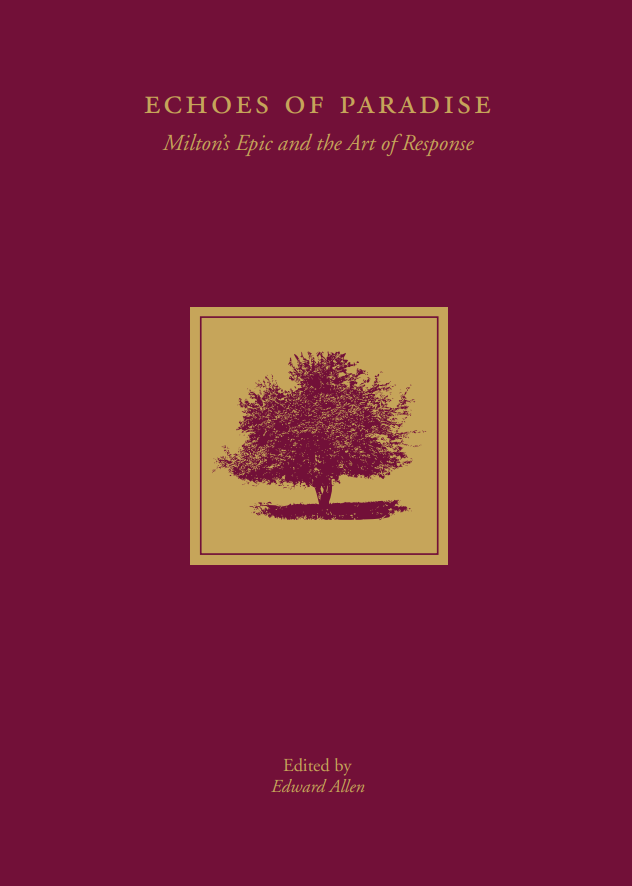
Back in 2017, Christ’s College, Milton’s alma mater, hosted an event to mark the 350th anniversary of Paradise Lost’s publication. This was no ordinary celebration. The purpose, beyond recognising the poem’s long historical influence, was to imagine and articulate some of the places it may take us, creatively and critically, in the present. The book for which this piece was originally written as an introduction, Echoes of Paradise, was an elaboration of that imaginative process. Each contributor to the book thought at one time or another of Christ’s as a home, just as Milton did; some of us still do. Do good walls make good critics? Whatever value there may be in knowing a place, and in knowing the place young Milton read and wrote, played and played up, the spirit in which the collection was intended had to do with the reach, and not the coddling embrace, of his epic poem. In Echoes of Paradise you will find a variety of responses to Paradise Lost, and a variety of responses to those responses. And without claiming to have achieved anything like a comprehensive insight into the poem’s afterlives, the book’s rather unruly understanding of what it might mean to respond to something like a poem – in poetry or music, painting or fiction, memoir or performance – confirms our sense that a proper response must seek to disrupt as well as enhance the things we think we know.
[1] ‘The Cell’ (series 5 episode 3), Spooks; broadcast on 18 September 2006; written by Ben Richards.