31.03.26
Pasquale Toscano reflects on Milton's sonnet 19, and how it contends with both the difficulty of disability, and its capacity to widen the poet's—as well as the author's, and our own—worlds


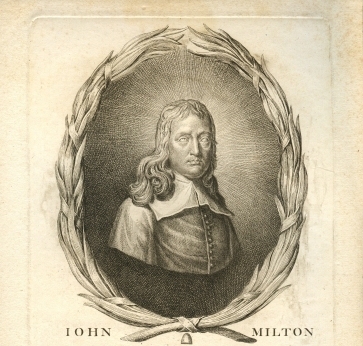
Likely written in the wake of Milton’s total blindness, “Sonnet 19” (c. 1653) has long been considered one of the most personal, haunting, and—what else?—beautiful poems in his corpus, all the more notable for its message of enduring in troubled times. Plangently, the first eight lines—or octave—asks a question with major stakes: How can we be expected to use a God-given talent in full—as the Bible (sometimes) suggests we are—after losing the means to deploy it in the first place? By contrast, the last six lines—or sestet—reassure us that doing nothing is, in the end, perfectly fine, prior ambitions be damned. It’s one’s faithfulness that matters. This makes for a conclusion more ambivalent—and tonally complex—than scholars have often allowed.
For me, this poem strikes both visceral and intellectual chords, partly for assuming disability as its keystone theme. I proudly identify as disabled myself. But before getting to why, let me touch on two points of taxonomy: disability is used, here, to describe the transhistorical experience of disability-like difference, even before the identity we now call “disabled” conspicuously arose in the nineteenth-century. The term therefore denotes any somatopsychic feature that limits function, elicits stigma, or effects some combination of both. I say somatopsychic because the body and mind are so often interconnected that disability scholars speak of a bodymind, which nicely reflects the imbrication of these components in dominant early modern theories of embodiment, like humoralism, too.
Now, then, back to me: in 2013, at age nineteen, I experienced a spinal cord injury that briefly paralyzed my body below the waist. I’ve walked with a cane and brace ever since. The eighteen years beforehand were mostly charmed, and I spent them being told—by parents, friends, and the people I’d see every Sunday in church—that God well knew the plans that he had for me. These centered on my mind: I was expected to enter the public sphere, probably as a lawyer, and present a true account of my own, in the words I’d always been able, quite aptly, to phrase. But then, suddenly, I was neither going anywhere nor following up on any plans other than relearning to walk.
In the “dark world and wide” of the next few months, I encountered Milton’s sonnet for the first time, thanks to a professor who discussed poetry with me every week; this was her idea, to offset the crises of rehabilitation. (She’d call from the car, while watching her son practice soccer.) I was in mourning, feeling the failure, and Sonnet 19 gave me reason to celebrate something as small as getting to my feet, which was now an exceptionally laborious task. “They also serve who only stand and wait,” a personification of patience says at the end. Who was I to disagree?
These days, I’m less demure. My goal here is to show that Milton’s Petrarchan structure—of an octave resolving into the sestet, via the turn of a volta—lulls us into a false sense of security about what becoming disabled means. This (flawed) meaning hinges on a literal, quietist, ultimately insufficient grasp of those final two verbs.
Insufficient because the more I reread the poem, the thicker its laminated ironies become. What Milton narrates here is a dawning revelation: the speaker’s inchoate awareness of an identity we might call crip—a transgressive reclamation of cripple, our community’s counterpart to queer—and one that’s forged in the crucible of lived experience, where disability brings grief and gain, alike, and is all the worthier of our attention for generating both at once. Milton has thus become, for me, a crucial ancestor. One of his many lessons has been that the tragic frame I initially brought to my changed and changing body was incommensurate to the complexities it actually posed.
Key to this revelation were the poem’s two central paradoxes. First, as the world of the speaker—let’s call him Milton—darkens, it also widens. And second, though we might expect this widening to prevent Milton’s talent, the exposure forces his aptitude into the open. It is easier, of course, to flatten out these pleats. But we do so to our detriment: they offer a fuller sense both of this sonnet and of Milton’s significance to the material realities of crip folks even now.
The first of these paradoxes finds rhetorical expression early in Milton’s poem, but slyly. Though the sonnet had become a highly artificial form by 1653, Milton strikes a conversational pose at the start, his words meandering in their subordinate clausation. “When I consider how my light is spent,” he begins, only to twist the train of thought in the next line with a further qualification, “Ere half my days.” It’s this marker of time that flows into the relevant phrase, “in this dark world and wide,” another of those circumstantial clauses. For perspective, it will be a further six lines before we get to the subject and main verb, “I” and “ask,” respectively.
But burying the treasure, to be excavated, is partly the point. After all, it’s withering work to make sense of a nonplussing world both “dark” and “wide.” (How can one see the width?) Stranger still, “wide” is hyperbatically flung apart from “dark,” emphatically at the end of the line, yet rolled over by the polysyndetic effect of those two bookending ands. No wonder that “wide,” here, rhymes with “hide.” Given cultural stereotypes from Milton’s day, and from our own, the notion that blindness might actually widen the world—even while darkening it—is, in fact, hidden.
As a result, we focus on the woeful alliteration of “w”—“world,” “wide,” “which,” and so on, through to “wait.” This dolorous soundscape seems to unify the poem, which takes the form of an urgent frustration: Milton wants “[t]o serve … [his] Maker,” with the “one Talent which is death to hide”—presumably his literary acumen. Yet, given his blindness, this faculty is “Lodged with [him] useless,” even as his soul’s “more bent” to serve the Lord via “day-labour.” As mentioned, however, “patience, to prevent / That murmur, soon replies.” Perhaps with the parable of the workers in the vineyard in mind, it commands the speaker not to worry about doing anything with his talent: “God doth not need / Either man’s work or his own gifts.” After all, there are many ways to serve the Lord—and having nothing to show for oneself, in material terms, is in this sense perfectly fine. It’s also in keeping with the ardent—and iconoclastic—Protestantism Milton was known to espouse.
There’s only one problem: the formal currents of the poem sluice against this message. To start, the volta—“But patience”—comes a line early, as if Patience can’t help but intervene, never mind that haste is bound to make waste. Indeed, our sense of uneasiness soon intensifies: syntax and lineation (and stanzaic divides) increasingly conflict, as the language grows evermore technical. The consequence is that—against the octave’s humanity—a robot seems to commandeer the stage.
Consider, for instance, the bramble of infelicities snagging us in this bit of the poem: the archaic, and thus legalistic, form of “doth,” tongue-tying after the dental-ending “God”; the knotty alliteration of “not need”; and the inopportune enjambment thereafter of “Either man’s work or his own gifts.” (To what, exactly, does “his” refer: likely man, but possibly God himself, who’s appeared just one line before?) What follows the semicolon in this same line only adds to the awkwardness, as antecedents are withheld and the language gets curter as a result: “who best / Bear his mild yoke, they serve him best. His state / Is Kingly.” (Incidentally, this absolute, but not micromanaging, authority of God accounts for the poet’s republicanism: it renders any other being’s majesty, at best, carefully bounded; at worst, overweening in the extreme.) But we’re nowhere near done: there’s the nebulous “they”; the hamfisted repetition of “his,” which possibly toggles between antecedents, from “his own gifts” to “his mild yoke”; the heavy-handed alliteration of “b” and unexpressive ploce of “best” (“who best / Bear … best”); the banal emphasis on—of all things—a linking verb (“His state / Is Kingly”); and the elision of the verb are. This last bit isn’t odd, necessarily, except that it scrambles the parallelism after the “Thousands,” who are “at his bidding speed” and which “post o’er Land and Ocean without rest.” Meanwhile, we get rhymes so obscured—by hallmark Miltonic enjambment in one of its first sustained outings—that they hardly exist at all. What is the total effect? Patience never recovers from its angsty intrusion; in fact, it raises our hackles all the more.
We’re invited to ask, then, whether Patience accomplishes anything at all—if not formally, at least in terms of its stated aim. This goal is to “prevent” the murmur of line 7, “Doth God exact day labor, light denied?” (Those repeated liquid sounds, couched by ds, counterpoint the rebarbative bs of 10–12.) In no way, however, is the murmur—this curious essay—prevented: it precedes Patience’s response and, therefore, occurs, notwithstanding the intervention of Patience itself. After Horace on Homer, we might reluctantly sigh: Milton, too, can nod.
But this isn’t right. The apparent flaw of Sonnet 19 is the very thing that makes it so compelling in the first place. The fussy fecklessness of Patience should refocus us from its didacticism to its presence as a character in the speaker’s vital contest of reimagining himself.
What Milton stages here, in other words, is not the victory of Patience—or the triumph of acquiescence—in the face of adversity. Rather, he dramatizes a more multidimensional experience. He freezeframes the moment when physical transformation becomes nearly overwhelming or ostensibly tragic and then goes one step further, to suggest a less commonly adduced reason for this devastation: the voices such metamorphosis elicits, each with their own interpretation of events, from within and without alike. I was subjected to many of these after my accident: “What happened to you was horrible!” “At least you’re alive!” “God doesn’t give us more than we can handle.” “Everything has a reason,” and so on.
The challenge of the poem is to evaluate these perspectives against the material realities of one’s new and altered life—or here, against the specificities of the text. Any application of this test reveals that Patience’s wisdom comes up short. We’ve arrived, then, at the second paradox: in presenting prevention, Milton renders its intervention unnecessary, the murmur to which it responds obsolete. This is because, in presenting such a thing, he writes the very verse that Patience suggests he needn’t complete at all—the poetry whose loss has been mourned to begin with. Milton’s world might well be darkening, but his remit of artistic resources, experiential wisdom, and ethical knowledge—a la Rosemarie Garland-Thomson—is widening as a result. (So too, Milton’s insights into care and interdependence, as he collaborates with the amanuenses in his life—though that’s for another essay altogether.) His epistemology widens thanks to disability, which now becomes a central thematic concern: disability’s etiologies and ambivalences, its aesthetic and theological and phenomenological heft.
Let’s be clear, though: presenting failed prevention—or the collision of attitudes about physical de- and re-formation—does not mean telling us what we should make of disability. Milton has no patience for Patience. Rather, he enlists us in the work of reevaluating the cultural scripts of disability for ourselves—of questioning the wisdom we’ve received. Our task, then, is to construct intellectual frameworks of our own: ones at last commensurate to the material exigencies at hand.
Sonnet 19 therefore presents us with Milton, the iconoclast, in nuce, training his readers to follow in toe: a Milton who channels the roistering contest of views—which he’d spent the 1640s entering, and transcending, as a prose polemicist—into the different medium of verse.
This understanding naturally invites us to question the poem’s teleology, its final line, not to disparage the last two verbs but to redefine what they might mean. Stand and wait champion a particular kind of existence, in nonnormative positions at a nonnormative beat—or crip time—rather than at the pace of so-called fitter bodyminds. (Perhaps, then, Patience is more nuanced than I’ve allowed.) More to the point, they foreground a central tension of the poem by audaciously holding the anguish and possibilities of blindness in the same syntactic grasp. To stand and wait—this gesture of active readiness, this pose of enduring contemplation—captures the conceptual ambivalence of disability itself. Certainly, limitations of one’s bodymind pose challenges, in the twenty-first century, let alone in Milton’s seventeenth; and reclaiming the identity of crip needn’t mean sanding over roughness altogether. Yet learning to live with disability is learning that these trials are not the total phenomenology of our existence. They must be considered in tandem with the intellectual or creative or artistic triumphs disability inspires—not despite but alongside the trials themselves.
This doesn’t mean we should—or can—overcome somatopsychic dysfunction. Milton pushes us, rather, toward a more difficult truth: our feelings about disability will themselves be difficult. Even so, this difficulty makes the experience—which is so often framed as life-ruining and shameful—apt for serious intellectual engagement, as Milton’s three later masterworks reveal.
Take, for instance, his long epic, Paradise Lost (1667, 1674): it’s about the coming not only of sin but of the precarity that sin activated—that God built inexplicably into the human bodymind, to the ends of both intimacy and woe. Milton's theodicy here—his pledge “to assert eternal providence” at the end of the epic’s proem (PL 1.25)—can be traced back to the searching questions of Sonnet 19. Disability, as nothing else had, drives Milton to “justify the ways of God to men” (PL 1.26). By 1671, his brief epic, Paradise Regained, would climax with another moment of standing and waiting—by Jesus himself—that contradicts the passivity Patience once implied. Meanwhile, the tragedy Samson Agonistes (1671) aligns blindness with folly and pain, only to pull a rabbit-duck reversal: more limiting still, it reveals, is an inaccessible space, worsened by the gawks of scornful passersby. Milton is presenting prevention, widening darkness into light, till the end.
For a long time now, this width has given me the space I’ve needed to make sense of my own body. It’s given me the breadth to reframe my physique as something more than a cross to bear with dutiful patience, always standing, always waiting for one take or another but never my own. These days, I can foreground my perspective—after earning a PhD, joining the academy, and contributing to public discourse, as I’d always been told I could—because of the work Milton has taught me to do. To be sure, there are many reasons why folks become disabled, many ways of being disabled in the world, and I won’t say that Milton speaks to all of them. But I will say this much, at least: I've learned to post after my own fashion because he’s shown me how to harmonize the conceptual contraries of a life that’s crip. Such an existence moves rarely allegro though always at the pace of my lagging bodymind.

Pasquale Toscano is an assistant professor of English at Vassar College, after studying classics in Oxford as a Rhodes Scholar. He’s written about disability and embodiment for publications such as The Hopkins Review, the Los Angeles Review of Books, The New York Times, The Atlantic, and Vox while his scholarship—on epic and Renaissance literature—has appeared in various academic journals and essay collections. With Angelica Duran, he is the co-editor of Milton and the Network of Disability, Embodiment and Care (Edinburgh UP, 2026).