Milton and the Bible

Adam: first example of someone who ruined his life by taking banned substances that had been growing in his garden. It was his bird's idea and she got nicked as well.

- Adrian Plass, Bacon Sandwiches and Salvation (Authentic, 2007)


Paradise Lost and other major poems by Milton (Samson Agonistes, Paradise RegainedOn the Morning of Christ's Nativity) dramatize stories directly from the Bible, but references to the Christian text actually pervade the entirety of Milton's work, with biblical phrases and imagery everywhere in both his poetry and his prose. However, the Bible is not just relevant to Milton as a 'literary' source - in the seventeenth century, the Bible was used in various different contexts. In particular, it was often used to support stances on controversial matters, since the Bible was accepted by most people as an authoritative source. Milton quotes heavily from the Bible in his pamphlets against bishops governing the Church, his tracts in favour of divorce, and his writings defending the execution of the king.

The storyline of the Bible can be summarised in many ways. A useful way to view it for the purpose of studying Milton is to see it as a progression from Creation, through the Fall and the Redemption, and finally towards Consummation.
The Christian Story

From creation to consummation

Image
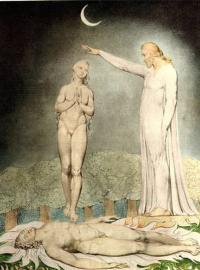
Creation of Eve

Creation

According to the Bible, God made the world, and everything in it, perfect. He created humanity, male and female, to look after and develop this world, and to live in perfect harmony with God and the rest of his creations. In Paradise Lost, the creation of the world is narrated by Raphael in Book VII, and the creation stories of man and woman are told by Adam and Eve in Books 8 and 4 respectively. The relationship of our first ancestors to the rest of creation is described in Book 4 of Paradise Lost through the eyes of Satan:

Two of far nobler shape erect and tall,

Godlike erect, with native honour clad

In naked majesty seemed lords of all,

And worthy seemed, for in their looks divine

The image of their glorious maker shone.

                                                     (4.288)

In the words of theologians Graeme Goldsworthy and Vaughan Roberts, Adam and Eve here are 'God's people in God's place under God's rule and blessing'.

Image
The Fall

Fall

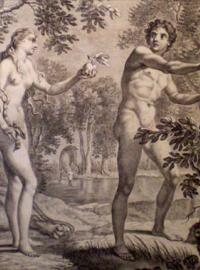
The first humans, Adam and Eve, are tempted by a serpent to rebel against God by disobeying his commands. Giving in to this temptation, they abandon their role as creations, and instead act as his competitors, disrupting the previously perfect relationship which was established between God and his creations. Their pride brings evil, pain, and death into the Garden of Eden, and subsequently into the entirety of God’s creation. Milton, along with the Protestant reformer John Calvin, saw this Fall as responsible for the corruption of human thinking and of human moral choices; he linked this further to a corruption of language, arguing that the Fall caused words to no longer hold knowledge in the way they were originally intended. 

In Genesis, it is not entirely clear how the serpent initially became evil and thus how he brings evil into Eden. Most Christians agree that God created all things good but that his creation is susceptible to evil, brought in by a separate independent force. This force is Satan – and by assimilating this knowledge, we can gather that the serpent is perhaps a representation of Satan, a conclusion which other parts of the Bible also suggest. Many Christians have settled on a theodicy (a justification of the divine in view of the existence of evil) in which evil originates in a rebellion against God by some of his angels. These angels, including Satan himself, were originally good like all of God’s creations, but their rebellion against their creator established them as evil forces against the divine. There are passages in the Bible (Isaiah, 14:9-15; Luke, 10:18; Revelation, 12) which can be read as referring to this, though each of these instances present interpretative difficulties. Milton followed and elaborated on this interpretive tradition of the 'fall of the angels'.

Image
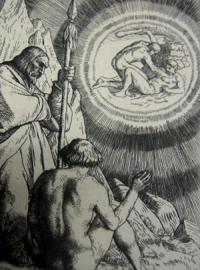
Michael summarises the events of the Bible for Adam - here Cain and Abel.

Redemption

God, after the fall of humanity, begins a plan to rescue and restore the glory of his creation, hinting at a chosen king who will come to rescue God's people and defeat the powers of evil. While in Genesis chapter 3, this reference is fairly cryptic, in Book 3 of Paradise Lost Milton uses the narrative of the Archangel Michael to elaborate on where the bible remains vague. 

Over a long period of time, God reveals himself to different individuals, making a covenant with them that they will be his people representing him to the world, and that he will be their God, protecting and providing for them. Over time, these people become the nation of Israel, and, despite their frequent rebellion against God, he stays true to his covenant. Milton, along with other thinkers of his time, used the biblical history of Israel to debate the qualities and advantages of different political systems.

Eventually, after the nation of Israel had fallen under Roman control, God's Son, Jesus, is born into the people of Israel as the promised chosen king (Messiah/Christ). When he reaches adulthood, Jesus teaches about God's reign and performs miracles before he is executed on the cross by political and religious authorities. However, soon after his death, Jesus is resurrected and ascends to heaven, catalysing the defeat of sin and demonstrating the omnipotence of God. Milton (especially in Paradise Regained) tended to focus primarily on the teachings of Jesus, rather than the story of his miraculous resurrection.

Image
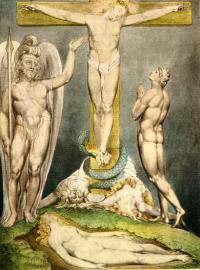
The crucifixion

Consummation

The victory Christ has accomplished is not yet fully visible. Christians believe that one day, Christ will return to enforce his victory and destroy the powers of evil. In between, God is shaping a people, the Church, to be a sign and a foretaste of this. Milton, as Christians still do today, lived in this period of expectation.

Many Protestants in the sixteenth and seventeenth century argued that the institution of the Church had become corrupt, and that the True Church was not the 'visible' Church which has its presence in this world, but an 'invisible' church, made up of all true believers and known only to God. As many other Protestants did at the time, Milton identified the Pope and the Catholic Church as being the focus of the powers of darkness described in the book of Revelation (e.g. the dragon and the city of Babylon). Some of the Parliamentarians and Puritans saw the Royalists and bishops of the Church of England as also being on the side of evil.

Milton saw the fallenness of the world and the loss of Eden described in Paradise Lost as leading to a fragmentation in our lives, our relationships and our understanding. In Areopagitica, Milton's book in defence of the freedom of the press, Milton expresses this metaphorically by depicting Truth as a beautiful virgin who has been hacked to pieces by deceivers. In this in-between time in history we need to try to put these pieces back together, and this, in Milton's view, was the main purpose of education. Yet we have to wait until the second coming of Christ to see these fragments of Truth put back together into a beautiful whole body:

We have not yet found them all, Lords and Commons, nor ever shall doe, till her Masters second comming; he shall bring together every joynt and member, and shall mould them into an immortall feature of lovelines and perfection. (CPW, II.549)

Milton tells us that it is our responsibility to seek the truth, but that we will not see it in its wholeness until God's final victory reverses the loss of paradise. This is the paradox of living in the in-between time.

We have not yet found them all, Lords and Commons, nor ever shall doe, till her Masters second comming; he shall bring together every joynt and member, and shall mould them into an immortall feature of lovelines and perfection.

Milton, Areopagitica