The Miltonic Mill: Post 1

30.01.26

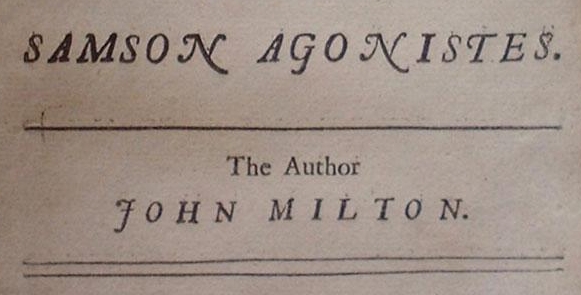
For our first blog post, Katrin Ettenhuber, editor of Milton's Samson Agonistes, guides us through the play's 'advanced darkness', via Spongebob's Bikini Bottom. Samson Agonistes is a tragic closet drama—a play not intended to be performed—based on the biblical story of Samson, which Milton published alongside Paradise Regained in 1671. 

Read on to enter the darkness...

‘Advanced Darkness’ in Samson Agonistes

Katrin Ettenhuber


In a famous episode from Season 1 of the animated television series SpongeBob SquarePants, the title character finds himself in a place called ‘Rock Bottom’. Unlike SpongeBob’s home, the sunlit underwater city of ‘Bikini Bottom’, ‘Rock Bottom’ is located in the so-called aphotic zone of the ocean, a region of perpetual darkness. ‘Aphotic’, from the Greek ‘a-’, meaning ‘without’, and ‘phōs’, meaning ‘light’, refers to areas of the ocean where sunlight cannot penetrate; this prevents photosynthesis, and therefore the production of oxygen and energy. SpongeBob experiences the blackness of the aphotic zone as a physical force, as an oppressive, suffocating entity. Short of breath and in the grip of a rising panic, he observes, in what has since become one of the show’s best-known memes, ‘this isn’t your average, everyday darkness. This is [pause] ADVANCED DARKNESS.’ At this lowest point of despair, help arrives from an unexpected source, in the form of illumination and inspiration. An anglerfish provides light through its bioluminescent lure (a stalk on its head) and inspiration by dint of its ability to breathe in aphotic conditions: ‘inspiration’, from the Latin verb ‘inspirare’, literally means ‘to breathe into’. The anglerfish inflates a balloon that allows SpongeBob to float upwards, thus releasing him from his immersion in life-threatening obscurity.

Milton’s Samson is not so lucky. His experience of darkness is more complex, intense, and enduring, with illumination and inspiration in conspicuously short supply. Samson’s darkness is an ‘advanced darkness’ that will graduate, less than a hundred lines into the text, into a ‘total Eclipse / Without all hope of day’ (ll. 81-2). Milton tells us that, as a blind man, Samson inhabits a ‘land of darkness’ (l. 99), but his condition is not merely physical, and his darkness is not simply a deprivation of light. It is at once a metaphysical and an inward darkness, but Milton presents even these abstract terms as tactile, embodied, and substantial. The phrase ‘land of darkness’ is an allusion to the Old Testament Book of Job, where Job asks God for respite ‘Before I go … to the land of darkness[.] … A land of darkness, as darkness itself; and of the shadow of death, without any order, and where the light is as darkness’ (Job 10:21-2). The two Hebrew word for darkness in the phrase ‘A land of darkness, as darkness itself’, ‘epatah’ and ‘opel’, resonate with the notion of an advanced – or advancing – darkness. ‘Opel’ does not just signify the onset of night or the end of daylight but refers to an active quality of darkness that inhibits movement and perception; ‘epatha’ derives from the Hebrew word for the verb ‘cover’: it’s a darkness that smothers and suffocates. In Samson Agonistes, darkness has a tangible, tactile quality from the start, as Samson feels his way to the ‘dark steps’ (l. 2) of the bank on which he wants to rest. Initially this seems like a welcome escape from his prison routine (‘here I feel amends’, l. 9), but we quickly learn that Samson carries the prison with him wherever he goes. And the darkness acts upon him and against him even in the broad light of day, making his vulnerability more visible to his enemies and subjecting him to further pain and humiliation:

              … the vilest here excel me
They creep, yet see, I dark in light expos’d
To daily fraud, contempt, abuse and wrong. (ll. 74-6)

A few lines later, darkness assumes an existential totality that seems to disrupt the structural integrity of Milton’s verse:

Scarce half I seem to live, dead more then half,
O dark, dark, dark, amid the blaze of noon,
Irrecoverably dark, total Eclipse
Without all hope of day! (ll. 79-82)

Samson Agonistes is predominantly written in iambic pentameter. But there are sections where Milton significantly deviates from his template; these deviations are always functional – they signal or perform key ideas through particular metrical effects. In the quotation above, for example, the first four syllables of line 80 – ‘O dark, dark, dark’ – do not conform to the usual iambic alternation of unstressed and stressed syllables (try scanning ll. 1-3 of Samson as an example of a regular iambic rhythm); all four syllables are palpably stressed, and the triple repetition of the word ‘dark’ creates a sense that the stresses intensify as the line unfolds. Instead of two iambs, ‘O dark, dark, dark’ (I’ve marked the stressed syllables in bold), we have two spondees: ‘O dark, dark, dark’. This is because Milton wants his readers to feel some of the crushing, oppressive force of the darkness Samson is experiencing here. As we move into line 81, the word ‘Irrecoverably’ seems impossibly scrambled (try saying it out loud), and when we finally emerge from its five syllables, as from a long tunnel, what awaits us is another instance of the thumpingly stressed monosyllable ‘dark’, followed by a metrical inversion that puts the emphasis on the first syllable of ‘total’. Milton’s verse leaves the reader feeling confused and disoriented, burdened with a leaden sense of obscurity that gives us a glimpse, paradoxically, of what it might be like to experience a ‘total Eclipse’ of the soul.


Milton’s depiction of darkness as a tangible, substantial presence is unusual when we consider it in the religious context of his time. Darkness had, at least since St. Augustine, been defined as the absence of light. In a treatise entitled Concerning the Nature of the Good, Augustine argued that ‘darkness is the absence of light in the same way in which silence is the absence of voice’ (ch. 15). In this passage, Augustine uses the word ‘absentia’ in the original Latin, but elsewhere in his work he describes darkness as a form of ‘privation’ (Lat. ‘privatio’): as a removal, withdrawal, or negation of light. The reason for this choice of terminology was theological. Augustine’s definition of darkness emerged from controversial debate with a group called the Manichaeans (named after their founder, Mani), who posited that the universe was governed by an eternal struggle between two opposing principles: light, equated with good, and dark, equated with evil. In this conception of the world, both forces were equally real, and darkness was therefore a real substance, not an absence or lack. For Augustine, Manichaeism constituted a direct threat to God’s sovereignty: if there is a rival power of darkness or evil, then God cannot be omnipotent. The solution was to deny evil an independent existence, and to define it as the subtraction of good. ‘Evil’, Augustine says, is ‘the privation of good’; ‘evil is not a substance’ (Enchiridion: On Faith, Hope, and Love, ch. 3). Augustine’s argument won out, and his theory of darkness and evil as privation left its mark on many early modern writers. In John Donne’s ‘A Nocturnal upon Saint Lucy’s Day’, for example, the speaker mentions ‘dull privations’ and imagines himself as something ‘re-begot / Of absence, darkness, death; things which are not’ (ll. 16, 17-18). To be clear, I am not suggesting that Milton was a secret Manichaean who installed a rival God of darkness in Samson Agonistes. Samson experiences his suffering as privation, as a withdrawal of God’s light: ‘Light the prime work of God to me is extinct’ (l. 70); ‘Let there be light, and light was over all. / Why am I thus bereav’d thy prime decree?’ (ll. 84-5) But Milton is far more responsive than the Augustinian position stipulates to the idea that darkness can be felt and experienced as a substantial presence, as a force that acts and moves within us. 

But if darkness is a state of being, rather than merely the absence of God’s favour, it must be engaged with, and it calls for interpretation. It’s clear that in Samson Agonistes, darkness is not preparatory to, or a medium for, illumination. In the Bible, some of the most important prophetic visions (by Daniel or Zechariah, for example) happen during the night, and the catalyst for turning Paul from a persecutor of Christians into a fervent preacher of the Gospel is a temporary state of blindness that kindles an inward light. In Samson, however, the causes and meaning of darkness remain stubbornly obscure. Samson endures without the comfort of clarification, and when he finally acts it is without the blessing of a definitive revelation. Physical disability does not give way to spiritual illumination: Samson’s soul ‘In real darkness of the body dwells’, ‘incorporate with the gloomy night’ (ll. 160, 162). Rather than functioning as a guiding light, Samson’s soul becomes absorbed into the ‘real darkness’ of his body. The addition of the word ‘real’ is pointed because it establishes Samson’s darkness as ‘[h]aving an objective existence’; as ‘actually existing physically as a thing’; as ‘substantial’ (Oxford English Dictionary, ‘real’, adj., I.1.a).

What are the implications of living in such a ‘land of darkness’? In the Geneva Bible’s gloss to the passage from Job that Milton is referencing in Samson, we learn that the Joban text ‘makes no distinction between light and darkness’; it is a place ‘where there is very darkness itself’. The tautology – very darkness itself – tries to give tangible form to Job’s dilemma: like Samson, he struggles with the obscurity of God’s will, with the absence of divine legibility. In Milton’s text, this inscrutability finds climactic expression in what Samson refers to as his ‘double darkness’ (l. 593) and provokes difficult questions about what Samson’s final actions, and his death, might signify. Milton is careful to avoid language that indicates divine revelation or command: Samson feels ‘Some rouzing motions’ (l. 1382) of unspecified origin and then goes on to state that ‘If there be aught of presage in the mind, / This day will be remarkable in my life’ (ll. 1387-8). Enveloped by cognitive, spiritual, and physical obscurity, Samson can’t even tell if his mind is still capable of receiving omens or prophecies, let alone if it is capable of interpreting them. And ‘remarkable’ could refer to something good or bad. Because of the way Milton has set up darkness as a palpable, active force, Samson’s moment of decision becomes a deadly version of ‘things that go bump in the night’: the ‘rouzing motions’ could be the psychological equivalent of an unsettling noise that triggers a hypersensitive mind, or a divine call to action. After the destruction of the Philistine Temple at Gaza, which kills Samson and thousands of Philistines, the darkness that has shadowed the protagonist is, to some extent, transferred to the reader. Was Samson acting as an instrument of providence or out of a human desire for revenge? Can an action performed in epistemic darkness be a sign of faith, even when the conditions of faith are unknown and cannot be felt? Because Milton has obscured the criteria we normally use to evaluate actions – the agent’s intention, authorization by a higher force, intelligible outcomes and consequences – the audience too must endure in a state of uncertainty, and without the reassurance of moral closure. The ‘land of darkness’, then, is not simply a place where evil dwells. It is, rather, a chronic condition of the fallen human mind, which has to feel its way through a complicated world with few signposts and even fewer answers.

Darkness Visible aims to shed light on Milton’s works and provide signposts through their complicated worlds, but not to the point of defusing its darker or more complex moments. These monthly blog posts provide space for academics, students and teachers to delve into some of these in greater detail. 

Katrin Ettenhuber is a Fellow and Director of Studies in English at Pembroke College, Cambridge. She works mainly on the literary and intellectual culture of sixteenth- and seventeenth-century England and is the author of The Logical Renaissance: Literature, Cognition, and Argument, 1479-1630 and Donne’s Augustine: Renaissance Cultures of Interpretation. She is currently editing Milton's Samson Agonistes for Longman's Annotated English Poets.