Milton has a reputation as a highly ‘Latinate’ poet. Across his career, the form, style and content of his writing is highly influenced by and imitative of the Latin language and literature written in Latin. Some early readers, recognising this trait, actually turned Milton’s verse into Latin, composing and publishing Latin translations of his poems, especially Paradise Lost.
In the hundred years after the publication of Paradise Lost, at least three complete Latin versions and many partial translations, especially of book 1, were published. This might seem an odd thing to do: why translate a modern English poem into a ‘dead language’, especially after Milton channelled so much of his poetic energy into translating his Latin models (such as Virgil) into the English tradition in Paradise Lost?
There are several answers to this question. For one thing, Latin was not fully ‘dead’ in the seventeenth and eighteenth centuries. Milton was not only influenced by classical Latin poets; he was a Latin poet himself, and much of his prose is also in Latin—his first volume of poetry is titled Poems of Mr. John Milton, Both English and Latin (1645). Alongside familiar poems like ‘Lycidas’ are less well-read Latin poems like ‘Epitaphium Damonis’ (‘Epitaph for Damon’, an elegy for Milton’s best friend Charles Diodati) and ‘In Quintum Novembris’ (‘On the Fifth of November’, a poem on the Gunpowder Plot). Like most well-educated people in the seventeenth century (though Milton was much better than most!), Milton’s schooling included extensive instruction in Latin grammar, composition, and literature. Latin was not only a living literary language but also had a pragmatic, communicative function as the language of the ‘Republic of Letters’ or the international intellectual community. Milton himself served as Latin Secretary (officially, Secretary for Foreign Tongues) for the English Republic in the administration of Oliver Cromwell, employing his Latin on a daily basis.
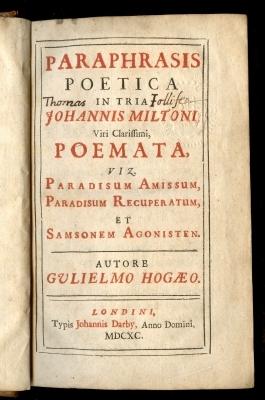
These uses of Latin continued after Milton’s lifetime into the eighteenth century, gradually declining with the rise of French and then English as international languages. Thus, many of the Latin translators of Milton wanted to make his major works accessible to an international readership through Latin—for example, in 1690, one translator, William Hog, lamented the fact that Paradise Lost has ‘remained unknown until now to foreign regions’ because it was written in English, still a relatively minor language. Hog seems to have achieved a degree of success in this regard—his version of Milton, first published in London, was reissued in Rotterdam in 1699.
This wasn’t the only motivation to ‘Latinize’ Milton. The phenomenon of translating English poetry into Latin in print was not exclusive to Milton: from the late-sixteenth century, works from the emerging canon of English literature from Chaucer onwards were ‘Latinized’, also including Edmund Spenser and Alexander Pope. Translators were generally motivated by four main kinds of ambition:
- Geographic: reaching readers overseas
- Temporal: trying to preserve English literature in a language considered to be more stable and durable than English. Surprisingly, many early modern writers thought that English would die out!
- Political: adapting or promoting the politics of a work for a new era
- Literary: the desire to canonise an author, to see their work mirrored in Latin (particularly if the poem is already ‘Latinate’ to start with), and/or for the translator to self-promote in the literary marketplace
The latter two impulses were particularly common among the Latin translators of Milton, since Milton’s republican politics were highly controversial after the Restoration of the monarchy, and since the eighteenth century was a period in which the canon of English literature was beginning to solidify. These two factors were intertwined: some translators (like contemporary publishers and editors of Milton) were motivated by a cultural desire to create a canonical, depoliticised ‘Milton’, de-emphasising the radicalism of his poetic works relative to that of his highly divisive prose.
Perhaps the most fundamental motivation, in Milton’s case, was to pay tribute to the ‘Latinism’ of Milton’s English by exploring what it would look like or would have looked like in Latin. Translation functioned as a form of commentary on the text—for example, a translator could show that he recognised a Miltonic allusion by quoting the Latin source in his translation, revealing moments of affinity and difference to predecessors like Virgil.
We have a copy of one of these translations, by William Hog, at Christ’s College. Hog ‘Latinized’ all Milton’s major poetic works (Paradise Lost, Paradise Regained, Samson Agonistes, ‘Lycidas’ and ‘Comus’), with the patronage of the Royal Society Fellow and colonial financier Daniel Coxe. The patron Coxe had imperialist visions of Milton achieving world domination in Latin, whereas Hog himself seems just to have wanted to relieve himself of the penury he had experienced since moving from Scotland to England. Yet Hog would die on the streets of London in 1702, suggesting that Latinization was not a particularly lucrative or prestigious enterprise for a ‘hack’ writer around the turn of the eighteenth century. His experience was shared by some other Latinizers after him—even for Joseph Trapp, first Oxford Professor of Poetry, Latinizing Paradise Lost was a costly failure.
An especially interesting twist in this tale is the so-called ‘Lauder Controversy’, when a forger called William Lauder tried to frame Milton for plagiarism by slipping some passages of Hog’s translation into a collection of Milton’s Latin ‘sources’—as if Milton had copied his own translation! This unusual event speaks to our sense that Paradise Lost reads as if it were translated from a Latin poem, in an effect which provides an analogy for the linguistic Fall from Edenic language.