
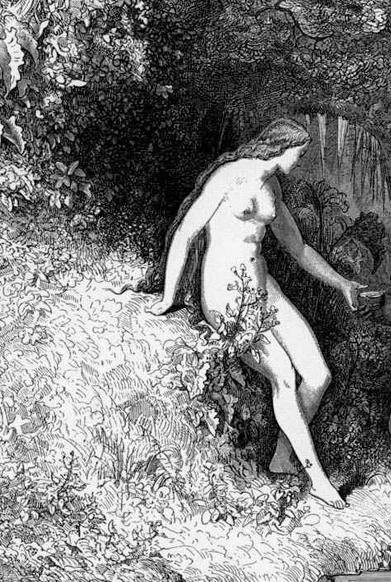
Eve embodies every mother, daughter and sister. Other women are compared to her, like Mary, mother of Jesus, who is described as a 'second Eve' (10.183). She is beautiful and slender, a fair creature with golden hair.
Milton's Eve is Adam's counterpart and other half but she is crucially not Adam's equal. This imbalance between the couple, with Eve as the more submissive and subordinate of the two, is evident in Paradise Lost both before and after the Fall, before Eve does anything wrong. This is in contrast to the story in Genesis in which it is only after the Fall that Eve seems second-rate in relation to Adam.
Eve is blamed for the Fall because she is tempted by Satan to taste the fruit from the Tree of Knowledge. She is tricked, but it is, at least in part, her own fault; she wanted to be tested, to prove herself, and so put herself in harms way, and, once the idea is suggested by the serpent, she persuades herself and then Adam to eat the fruit. She is portrayed as innocent, making a childish mistake in her inexperience in dealing with falsehood, but at the same time she is characterized as foolish in more adult ways, as both sexualized and vain. When she is first introduced to Adam she is narcissistically distracted by the sight of her own reflection in a pool of water. This is a symptom of Eve's susceptibility to be lead astray and demonstrates that some of her main failings, being inclined to distraction and following her desires, are present in Eve before as well as after the Fall. It is her combination of naivety, greed and self-importance which make Satan's suggestion so successful.
This negative view could be explained by the fact that Milton was writing from a post-lapsarian (i.e. post-Fall) perspective. The view of women and their sexuality was tainted by the Fall, and centuries of blame traditionally placed at Eve's feet. It is impossible to imagine Milton treating Eve in a way that is not partly misogynistic because he is writing a story which is fundamentally anti-female. However, Raphael calls Eve, 'mother of mankind' (5.388), alluding to the idea of felix culpa or 'Fortunate Fall'. Eve may bring about the Fall of Man, but this in turn brings about the coming of Christ.